Official websites use .gov
A .gov website belongs to an official government organization in the United
States.
Secure .gov websites use HTTPS
A lock (
) or https:// means you’ve safely
connected to the .gov website. Share sensitive information only on official, secure websites.
Imagine a hurricane crippling one of the country's largest intravenous (IV) fluid production facilities. In the aftermath of Hurricane Helene, that's exactly what happened. Hospitals and clinics depend on IV fluids to provide essential care, and the disruption in supply posed a severe risk to patient health nationwide.
On April 10, the Angels for Change Drug Shortage Guardian Award was presented to the ASPR IBMSC team and their agency partners in recognition of their outstanding efforts to maintain a steady supply of IV fluids in the wake of Hurricanes Helene and Milton, a crisis that threatened healthcare facilities across the country.
Rapid Behind the Scenes Efforts
Baxter International, Inc. supplies approximately 60% of IV solutions used in North America. When storm damage from Hurricane Helene at Baxter's facility in North Carolina interrupted the company's ability to produce and distribute IV Fluids, the ASPR IBMSC team – including Joe Hamel and Steve Goddard sprang into action with counterparts Scott Kidd from the General Services Administration, Jonathan Culp and Erin Uyeshiro both from the Department of Homeland Security Customs and Border Protection, and Val Jensen from the Food and Drug Administration. Their collective mission? To prevent a critical IV fluid shortage that would have kept patients across the country from receiving the care they needed.
To achieve this mission, the interagency team:
Coordinated a massive importation effort - bringing in approximately 13.9 million IV fluid units on 98 flights from five international facilities to rapidly replenish the supply chain.
Streamlined customs clearance – required clearance steps that typically take 60 days were reduced to same-day priority review and received approval, ensuring IV fluids could be distributed immediately.
Safeguarded domestic supplies - just before Hurricane Milton hit, the team helped move 60 truckloads of IV fluids already in shortage to safety, ensuring these vital fluids remained available for healthcare facilities in need.
By thinking strategically and taking these rapid actions, the team was able to prevent a full-blown crisis that could have left an untold number of hospitals struggling to provide life-saving care.
The impact was noticed. Angels for Change, patient advocacy organization dedicated to ending drug shortages, singled out the effort for an award, calling the effort "extraordinary, unsung hero work that…saved many lives." The award highlighted the work that ASPR and its partners regularly do behind the scenes to support the private sector healthcare system supply chain after natural disasters and national emergencies.
Young Volunteer Takes Passion for Medicine from Classroom to Community Care
Cyndralynn Meredith, a Junior at Crete High School, has channeled her passion for helping others and preparing for disasters into so many great projects that people are noticing – people like Nebraska Governor Jim Pillen. Governor Pillen was so impressed with her outstanding dedication to service that he honored her with the Disaster Volunteer Award at the 2024 Step Forward Awards for Volunteerism.
Cyndralynn volunteers with the Southeast Nebraska Medical Reserve Corps, the Southeast Nebraska Community Emergency Response Team, and the American Red Cross First Aid Services Team. All three organizations channel the passion and enthusiasm of young people into meaningful projects that help their communities become healthier, more resilient, and better prepared. These programs also help teens develop their leadership skills and show them aspects of community health that they can't get from a classroom.
For over 15 years, the Medical Reserve Corps has partnered with the American Red Cross to attract and use the skills of volunteers to promote community health by helping prepare for, respond to, and recover from emergencies. Both the Medical Reserve Corps and the Red Cross provide outstanding opportunities to for teens, older adults, and everyone in between to find service opportunities that matter to their communities.
Cyndralynn has grown a passion for helping others and learning how to treat patients, and volunteering has given her some initial experience supporting patient care. As a volunteer, she has supported community events like the Cornhusker State Games, Pumpkin Run, and the Fourth of July celebration in Seward. Some of her favorite venues to be a First Aid volunteer are the Lied Center, Pinnacle Bank Arena, and Pinewood Bowl all in Lincoln, NB. Her passion for promoting health and helping others has translated into valuable contributions to her community through her volunteer efforts, and she has helped make her community a little more prepared for the next emergency.
Cyndralynn plans to attend college and train to become part of the medical field. Volunteering can help students learn about their career options while helping their communities. If you are interested in starting a Junior Medical Reserve Corps unit in your local school or encouraging students to volunteer with your existing Medical Reserve Corps unit, check out the MRC Unit Leader Resources and the Future Health Professionals (HOSA) MRC resources to get started. You can also reach out to your MRC state coordinator to learn more about starting a new unit.
Health Care Coalition Provides Crucial Support to Texas Hospitals During Simultaneous Cyber Incident and Inclement Weather
Rio Grande Valley, Texas March 20, 2025
Quick Look
Background
On March 20, one of the two Level 1 trauma centers in Texas’ Rio Grande Valley experienced a system-wide cyber incident. The hospital lost access to critical technology and records, with potential impacts to patient care. During the cyber incident response, the region’s other Level 1 trauma center was impacted by severe weather.
Response
Through exercises required by ASPR’s Hospital Preparedness Program, CBRAC knew how to efficiently respond. The health care coalition worked with their wide network of members to quickly mobilize previously purchased redundant communications systems, support laboratory and pharmacy services, and support patient movement across a large hospital system. CBRAC kept patient needs at the forefront as they responded to the evolving incident.
Impact
CBRAC’s actions maintained patient safety, coordinated patient movement, and minimized disruptions to care for the Level 1 trauma center and its network of facilities throughout the cyber incident.
On March 20 at 9:34 AM, Bernardino Palacios answered an unexpected phone call. Mr. Palacios, the Coastal Bend Regional Advisory Council (CBRAC) Program Director, was out of state when an emergency manager for the largest hospital system in CBRAC’s jurisdiction called to report a significant computer network intrusion. Mr. Palacios and his team immediately stepped in to help, mobilizing the CBRAC network and resources to respond swiftly and minimize disruptions to patient care.
CBRAC is a health care coalition supported by ASPR’s Hospital Preparedness Program, which provides funding and guidance to hundreds of health care coalitions across the nation. CBRAC oversees health care entities across three regions in Texas, including the Rio Grande Valley where the cyber incident took place. With support from the coalition, CBRAC members prepare for various emergency scenarios, including downtime in the event of a cyber incident. Extended downtime can impact technology and communications systems, access to patient information, and pharmacy and laboratory services, all of which can compromise patient safety.
To prepare for such scenarios, CBRAC conducts annual emergency preparedness and response exercises, drills, and risk analyses as required by ASPR’s Hospital Preparedness Program. This includes the Medical Response and Surge Exercise, a required annual functional exercise that tests a coalition’s ability to care for an increased volume of patients beyond normal capacity. CBRAC members also conduct bi-annual redundant communications drills on off-grid communication systems. These drills promote clear emergency operations and incident command structures for everyone responding to incidents.
Through these preparedness activities, health care entities under CBRAC’s jurisdiction had already identified and addressed gaps in availability of internet, handheld radios, and satellite systems. When the cyber incident occurred, the impacted hospital system was ready to respond.
The cyber incident began the morning of March 20 at one of only two Level 1 trauma centers in the region. Level 1 trauma centers are health care facilities that provide care for critical patients and are equipped to handle complex traumas. By the end of the first day, the cyber incident had impacted the entire Level 1 trauma center and over 120 clinics, hospitals, and campuses across multiple counties. Impacted entities lost access to crucial systems for patient tracking, charting, and laboratory and pharmacy services.
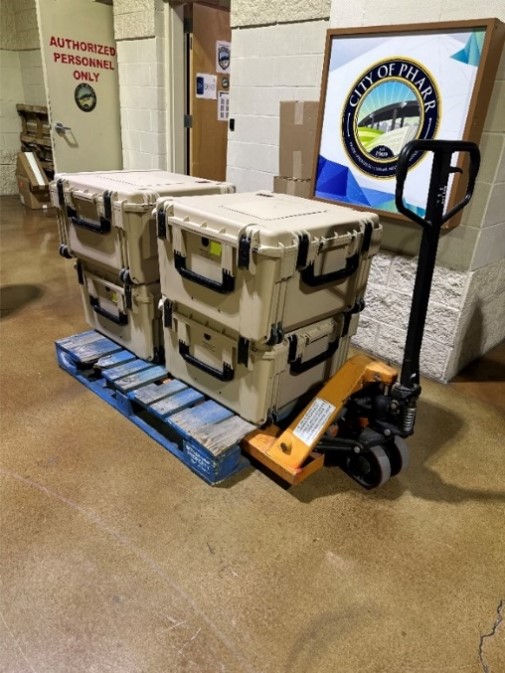
For the first 18 hours, CBRAC worked with its local members, as well as state and regional public health organizations, to get hospitals and providers back online as quickly as possible. CBRAC had previously used Hospital Preparedness Program funds to purchase 12 satellite devices for use when traditional communications are down. Just 14 minutes after Mr. Palacios received the call for help, CBRAC’s team prepared the satellites for pick-up. In less than two hours, the satellites were online, providing immediate, reliable internet and connectivity to the 120 impacted entities within the hospital system. With these backup communications devices, the hospital system could continue to provide crucial patient care.
Satellites readied for deployment to affected entities
For the remainder of the incident, CBRAC worked with hospital information technology and relied on its trusted partner network and redundant communication systems to maintain patient safety and continuity of care. For example, when pharmacy systems were down, CBRAC collaborated with the Drug Enforcement Administration for waivers to expedite controlled medication approval to patients in need. CBRAC also worked with impacted laboratory service providers to bolster capabilities and shift services to alternate locations.
Although pharmacy and laboratory services weren’t restored until March 29, CBRAC coordinated alternate avenues of care so that patient care remained uninterrupted. Additionally, the coalition relied on its vast member network across health care, emergency medical services (EMS), and other providers to coordinate the transfer of critical patients from the facilities under attack to multiple receiving health care facilities. As a result, all patient transfers were smooth and efficient.
On March 27, with ongoing cyber incident recovery, the region experienced severe weather that impacted the only other Level 1 trauma center. Suddenly, CBRAC was coordinating a multi-threat response. The compounding effects of the cyber incident and the inclement weather created technological and environmental accessibility issues, jeopardizing patient safety. Fortunately, CBRAC was prepared. With the satellite communications redundancy already in place, CBRAC led a continuous response in which no additional patients needed to be transferred out of the region. On April 8, 19 days after the cyber incident began, CBRAC turned off the last satellite and facility operations returned to normal.
Swift action, existing resources and plans, and effective communication enabled this successful response. The well-established partnership and existing trust between CBRAC and local health care entities strengthened response efforts and minimized disruptions to patient care.
“Health care coalitions serve a crucial role for health care organizations. Having trusted relationships established before the cyberattack made the facility willing to share information and trust that sensitive information wouldn’t be shared, which made the response smoother.”
- John Phillips CBRAC Division Director of Preparedness and Response
Cyber incidents threaten sensitive information, risk patient lives, and have the potential to spread rapidly. Knowing what to do when a cyber incident occurs, including who to trust and who to call for help, is crucial. Within minutes of this cyber incident, the Texas hospital system called CBRAC and revisited lessons learned from Hospital Preparedness Program-required activities like the Medical Response and Surge Exercise. With a trusted network, broad connections, and Hospital Preparedness Program-funded planning in place, CBRAC stepped in to support a large hospital system while minimizing disruptions to patient care.
MRC Critical Care Paramedic Spearheads Programs to Provide CPR, Opioid Treatment Administration Training
"Being part of the MRC allows me to give back to the community and use my medical training while doing it." - Jim Bollenbacher
Jim Bollenbacher, Nassau County Florida MRC
Jim Bollenbacher is a retired critical care paramedic from Florida. He is passionate about all things related to the heart, especially cardiopulmonary resuscitation (CPR).
To increase the impact of Nassau County MRC's ongoing Community Life-Savers Initiative, he set a goal for his 36-person unit: raise local awareness about sudden cardiac arrest and increase the number of county residents able to effectively perform bystander CPR (CPR performed by a non-medical person) by 2% in 12 months. Based on Nassau County's population, that meant training 1,700 residents by the end of the year. This goal was aggressive goal, but Jim believed in his team. "The MRC is an organization of amazingly talented, experienced, and compassionate people who are prepared to help their communities during a crisis or disaster. That takes a special type of person, and the MRC is filled with them."
Bollenbacher arranged hundreds of classes, personally providing training anywhere there was an interest: HOAs, fitness centers, county offices, schools, farmers' markets, and faith-based, civic, and private family groups. By the end of the year, he had trained 1,724 residents in hands-only CPR and 817 in opioid treatment awareness and naloxone administration. He and his team also distributed 126 CPR Anytime Kits in the community - far exceeding his unit's goals.
"The MRC provides an incredible opportunity to be of service to your community, to help when others are in need, and to be a part of something so much bigger than yourself," said Jim "I strongly encourage everyone to get involved in whatever way they can."
The MRC Recognition Awards recognize and highlight amazing contributions of MRC units, volunteers, leaders, and partners. In 2024, there were hundreds of nominations in 12 categories - covering both response and non-response contributions. Learn more about the awards and the winners at Meet Our MRC Network. Learn how to become a part of the MRC and make a difference in your community at Become an MRC Volunteer.
Health Care Coalition Planning and Coordination Saved Lives During Severe Flooding Event in Eastern Kentucky
Eastern Kentucky Region February 15, 2025
Quick Look
Background
In February 2025, eastern Kentucky experienced severe flooding after extensive rain fell on already saturated ground and waterways. Twenty-four counties in Kentucky were impacted, prompting early activation of the State Emergency Operations Center. This event marked the region’s third major flood within four years.
Response
The Eastern Kentucky Healthcare Preparedness Coalition, with support from local staff and funding through ASPR’s Hospital Preparedness Program, initiated proactive measures and positioned critical resources, enabling swift evacuations while supporting an acute care center’s shelter-in-place operation.
Impact
The response further strengthened coordination between state agencies, health care coalitions, and emergency support functions. The Department for Public Health and health care coalitions’ rapid and efficient assistance to impacted communities demonstrated the continued value of Hospital Preparedness Program-funded planning, partnerships, and resources.
On February 15, 2025, relentless rain swept across eastern Kentucky. As the rain fell onto already saturated and snow-covered ground, rivers and waterways began to overflow. The deluge quickly escalated into a catastrophic flooding event, impacting 13 counties in the eastern region and 11 others across the Commonwealth. As the waters rose, so did the urgency for a coordinated response to the lives of people in harm’s way—one that would test the region’s preparedness and the strength of its health care emergency networks.
In anticipation of unfavorable weather conditions, the Kentucky Department for Public Health and Kentucky Hospital Preparedness Program field staff activated their Regional Response Coordination Center, and Commonwealth officials activated the Emergency Operations Center. The Eastern Kentucky Healthcare Preparedness Coalition proactively began planning for possible evacuations and ways to support the health care sector. This early activation was not just a procedural step; it was a testament to the lessons learned from previous disaster responses and the effective communication mechanisms in place between health care and response partners.
The Eastern Kentucky Healthcare Preparedness Coalition is a health care coalition that receives funding and guidance from ASPR’s Hospital Preparedness Program. Kentucky contains eight Emergency Preparedness Coalition regions, each with designated Readiness and Response Coordinators. With Hospital Preparedness Program funding and guidance, Kentucky’s health care coalitions can establish partner networks, coordinate health care and emergency response, and host community-wide trainings and exercises, thereby promoting preparedness and strengthening regional readiness ahead of emergency events.
Prior to the flooding, the Eastern Kentucky Healthcare Preparedness Coalition strategically placed generators, ambulance buses, and evacuation and sheltering trailers in locations that had been previously impacted by extreme weather events. This foresight meant that when flooding escalated, these resources were already on the ground and ready to be deployed at a moment’s notice. As the floodwaters inundated communities, these prepositioned assets proved invaluable. Three ambulance buses, equipped to transport and triage multiple patients, were used immediately to evacuate a combined 241 patients from four nursing homes and one critical access hospital. The ability to move these at-risk patients quickly and safely was a direct result of the efforts made possible by the Kentucky Healthcare Preparedness Program and health care coalition’s networking, planning, and training. Field staff knew how to effectively respond to save lives prior to and during the flood thanks to similarly-focused training exercises, such as the Hospital Preparedness Program-required annual Medical Response and Surge Exercise. The team was also able to quickly deploy mission-ready response packages, such as evacuation equipment and ambulance buses specifically designed to safely evacuate facilities and transport patients while maintaining care.
The response to the flooding was a model for coordination and collaboration. Local Kentucky Department for Public Health and health care coalition teams worked together to coordinate the possible evacuation of a 113-bed acute care hospital, which included six intensive care unit patients. The hospital, surrounded by floodwaters held back by a flood wall, came within one or two feet of a catastrophic breach. Thanks to the robust medical operations coordination process, involving coordination between HCCs and regional partners, the hospital was able to shelter in place safely. Monitoring the situation, multiple hospitals and agencies across the Commonwealth engaged in real-time in case the facility needed to evacuate.
The Kentucky Healthcare Preparedness Program, Emergency Operations Center, Eastern Kentucky field staff, and Eastern Kentucky Healthcare Preparedness Coalition coordinated and shared resources, maintaining situational awareness internally and across coalition members.
"ASPR Hospital Preparedness Program funding directly supported our program and the Eastern Kentucky Healthcare Coalition team’s planning, resourcing, training, and exercising directly contributed to saving lives and the success of this response.”
- Kenneth Kik, Kentucky Healthcare Preparedness Program Manager, Emergency Preparedness and Response Branch, Kentucky Department for Public Health
The 2025 flooding marked the third major flood event in eastern Kentucky in just four years. Each time, the Eastern Kentucky Healthcare Preparedness Coalition has activated its Regional Coordination Center and response plans based on National Weather Service briefings, allowing for a proactive rather than reactive approach. This event reinforced the need to establish a medical operations coordination center, which would further enhance the region’s ability to coordinate complex medical responses. The response also highlighted the need for an additional ambulance bus in the Eastern Kentucky Healthcare Preparedness Coalition to expand capabilities. Plans are already underway to acquire and retrofit another bus using Hospital Preparedness Program funding, ensuring that the region will be even better prepared for future events.
The February 2025 flooding in eastern Kentucky tested the region’s emergency preparedness and health care response systems. Thanks to the effective partnerships, planning, and investments made possible by the Hospital Preparedness Program, the response was swift, coordinated, and effective. Patients and geographically at-risk populations were kept safe, hospitals continued to operate under extreme conditions, and lives were protected. The event stands as a powerful example of how effective planning, response, and coordination efforts prepare communities for disasters and save lives when every second counts.
Learn strategies facilities can use to prepare for and manage medical product shortages.
Banner Text
This page highlights resources to help our partners prepare for and manage medical product shortages and the allocation of scarce resources. These resources are either free/open access or include specific recommendations in their abstracts.
Trump Administration deploys fatality management, behavioral health specialists to aid aircraft collision emergency response at Reagan Washington National Airport
As part of the Trump-Vance Administration's commitment to support communities across the country in times of need, the Administration for Strategic Preparedness and Response (ASPR) deployed a team of fatality management and victim assistance specialists from the National Disaster Medical System (NDMS) to aid local responders following the January 29 midair collision at Reagan Washington National Airport. ASPR serves as the nation's primary health response and recovery agency for disasters and public health emergencies.
Additional information and support:
American Airlines has shared a toll-free number and said family of people who were onboard Flight 5342 should call 1-800-679-8215 for information.
The Disaster Distress Helpline is available to provide disaster crisis counseling. Managed by the HHS Substance Abuse and Mental Health Services Administration (SAMHSA), this toll-free, crisis support service is available 24/7 for people experiencing emotional distress related to natural or human-caused disasters. To connect with a trained counselor, call or text 1-800-985-5990.
At the request of National Transportation Safety Board (NTSB), NDMS' Disaster Mortuary Operational Response Team (DMORT) is working in collaboration with the DC Office of the Chief Medical Examiner to provide an assessment of fatality management needs. Personnel from NDMS' Victim Identification Center (VIC) team will support the family assistance center. Members of ASPR's Tactical Medicine Team were on the scene immediately after the accident to support responder care at the Incident Command Post set up at Joint Base Anacostia-Bolling.
In addition, ASPR's regional personnel worked alongside Washington, D.C. health authorities to determine additional unmet needs, resulting in the overnight deployment of experts from ASPR's Disaster Behavioral Health Team. The team conducted a rapid behavioral health needs assessment which District officials will use to put resources in place to support the family member's behavioral health needs.
"ASPR is honored to provide the additional hands and expertise that local, state, and federal authorities request during a tragedy like this," said Principal Deputy Assistant Secretary for Preparedness and Response John Knox. "We are always on call, and we rapidly deployed to support emergency personnel. Our team has tremendous experience working with local responders and families to identify the victims with dignity and respect."
ASPR's DMORT provides medical examiners, pathologists, forensic anthropologists, fingerprint specialists, forensic odontologists, dental assistants, administrative specialists, funeral directors, and other experts who can assist state and local medical examiners or coroner's offices in responding to mass casualty incidents. During an emergency response, federal partners or jurisdiction officials can request the assistance of an entire team or specific subject matter expertise within a team. These individuals work under the guidance of local authorities, providing technical assistance and personnel to recover and identify the remains of disaster victims.
Victim Identification Center team members provide technical assistance and consultation on the collection and management of information and related issues concerning people who have lost their lives in a public health emergency or disaster. The team may be called on to perform a wide range of functions, such as collecting dental records, fingerprints, medical records, DNA, and conducting interviews with family members to gather information, including DNA samples, to assist the medical examiner or coroner's office in accurately identifying human remains.
ASPR, part of the U.S. Department of Health and Human Services, is working closely with the NTSB and Washington, D.C., health and emergency response officials to determine any additional needs. More information about ASPR response operations can be found on the ASPR website.
Making Every Minute Count: The Northern Virginia Emergency Response System’s Response to the January 2025 Plane Crash at Reagan National Airport
Arlington, Virginia January 29, 2025
Quick Look
Background
On the night of January 29, 2025, a commercial flight carrying 64 passengers and crew members collided mid-air with a U.S. Army Black Hawk helicopter carrying three service members above the frozen Potomac River.
Response
Within minutes of the crash, the Northern Virginia Emergency Response System (NVERS) began coordinating response efforts, calling upon its established relationships and robust regional plans to quickly assess hospital capacity and mobilizing Hospital Preparedness Program (HPP)-funded fatality management resources. NVERS also led information sharing efforts with partners throughout the response.
Impact
NVERS’ ability to quickly coordinate the response to a large-scale, multi-jurisdiction incident demonstrated the continued value of the HPP-funded planning, partnerships, and resources.
On the night of January 29, 2025, the unthinkable happened – a commercial flight carrying 64 passengers and crew members collided mid-air with a U.S. Army Black Hawk helicopter carrying three service members. The collision occurred at 8:47 PM over the freezing Potomac River. At 8:50 PM, just three minutes after the collision, the Metropolitan Washington Airports Authority’s Fire and Emergency Medical Services (EMS) Department was already on the phone with the Northern Virginia Emergency Response System (NVERS), the health care coalition (HCC) that serves the Northern Virginia region
NVERS is an HCC that receives funding from ASPR’s Hospital Preparedness Program (HPP). With HPP support, HCCs establish response partner networks, build preparedness plans, and conduct trainings and exercises, all of which save time and lives in an emergency response. In Virginia, each HCC has a Regional Healthcare Coordination Center that acts as a single point of contact for emergency coordination of the health care sector and response partners. Each coalition has a 24/7 staffed hotline for its partners to call during an emergency, activating the Regional Healthcare Coordination Center.
As an HCC, NVERS takes a community approach to preparedness, partnering with traditional health care and emergency response entities, as well as those community partners outside of health care such as law enforcement, information technology offices, and 911 operators. Upon receiving the hotline call from Metropolitan Washington Airports Authority’s Fire and EMS Department, NVERS activated its Regional Healthcare Coordination Center. Through its Regional Healthcare Coordination Center, NVERS began establishing and maintaining direct communication between on-scene fire, EMS, hospitals, and local, regional, and state public health and emergency support functions.
By 8:52 PM, NVERS had assembled incident management team staff and activated the emergency alarms on its NVERS Radio system. The coalition had used HPP funding to equip every hospital and freestanding emergency department in the region with these NVERS Radios, intended to improve communication and coordination during an emergency. Thanks to this system, NVERS rapidly notified emergency departments of the disaster, prompting them to provide critical hospital capacity information to support response efforts.
Since the crash occurred in the National Capital Region, which includes Washington, D.C. and surrounding areas in Maryland and Virginia, the response required clear coordination of all operations across multiple jurisdictions and their respective agencies. In the years leading up to the response, NVERS collaborated with National Capital Region HCC staff in the District of Columbia and Maryland Region 5 to develop a suite of National Capital Region-specific plans that outline a coordinated approach to burn, trauma, and pediatric emergencies, as well as information sharing across the region. The information sharing plan outlines specific triggers and processes for notifying HCCs and their partners across the region so that there is clear and consistent situational awareness of events that have the potential to impact the entire National Capital Region. This plan enables HCC members to connect patients with the closest and most appropriate care during a disaster.
By 9:00 PM, all 30 NVERS hospital partners used the Virginia Healthcare Alerting and Status System to provide real-time information on their emergency department bed availability. Simultaneously, NVERS issued a text alert to promptly notify non-hospital partners including public health, emergency management, EMS, and other regional partners, such as the District of Columbia Health and Medical Coalition, of the crash. NVERS’ swift efforts to communicate and coordinate with partners streamlined potential patient routing and resource allocation efforts across the region.
During a response, HCCs such as NVERS serve a critical coordination role by maintaining clear and centralized communication between all parties. As the central point of contact, NVERS received frequent updates from the team at the scene of the crash and passed key information along to health care and emergency response partners. For example, the Defense Health Agency at Fort Belvoir, one of NVERS’ partners, called the coalition’s hotline requesting support identifying where the helicopter involved had originated. NVERS contacted the response team at the scene and confirmed that the helicopter had originated at Fort Belvoir, all within five minutes.
By 9:47 PM, the on-scene team contacted NVERS requesting temporary mortuary storage services that could be transported to the scene. In just seven minutes, NVERS identified an HPP-funded fatality management trailer located an hour away from the scene. Without hesitation, one of NVERS’ health system members in that area deployed a team to bring the trailer to the scene. Familiar with the traffic that occurs at all hours in the National Capital Region, NVERS mitigated any potential delays by coordinating with Virginia State Police to arrange a law enforcement escort of the fatality management trailer.
"Our coalition exists to care for our community on some of its most challenging days. We’ve spent a lot of time and effort and made risk-driven investments to ensure that there are immediate capabilities to serve our community during times of tragedy. It's really the investment in our day-to-day work that helps these unfortunate events go as smoothly as they do.”
- Andrew Slater, MA Deputy Executive Director of NVERS
Tragically, later that evening, the on-scene team notified NVERS that there were likely no survivors, and the response shifted to recovery. Despite the tragic outcome, the response demonstrated the value of NVERS’ robust regional planning and extensive multi-disciplinary, multi-jurisdictional relationships. This response served as a real-world test of NVERS' capabilities, proving that a well-prepared coalition makes every minute count when time is of the essence.
As we celebrate Martin Luther King Jr. Day on January 20th, we are reminded of Dr. King's powerful vision of a society built on equality, justice, and service to others. This federal holiday, designated as a National Day of Service, encourages all Americans to volunteer and improve their communities, embodying Dr. King's spirit of selflessness and commitment to positive change.
I became the Deputy Director of the Medical Reserve Corps because I am passionate about helping people and serving others and I see that same passion in Medical Reserve Corps volunteers.
The Power of Volunteerism
Dr. King once said, "We are caught in an inescapable network of mutuality, tied in a single garment of destiny. Whatever affects one directly, affects all indirectly." These words resonate deeply with the mission of the Medical Reserve Corps (MRC), a national network of approximately 300,000 volunteers dedicated to improving the health and safety of their communities.
Join the Medical Reserve Corps
The MRC offers a unique opportunity to honor Dr. King's legacy by serving your community. As an MRC volunteer, you can:
Contribute to local health initiatives;
Assist in emergency preparedness and response activities;
Provide medical and public health support during crises;
Promote community resilience and well-being.
Whether you're a medical professional, public health expert, or simply a concerned citizen, there's a place for you in the MRC. We need both medical and non-medical professionals in the MRC to address public health emergencies and strengthen community health.
Making a Difference, One Community at a Time
MRC volunteers have consistently demonstrated their invaluable worth over the years and their commitment to keeping our families, friends, and neighbors healthy.
In 2024, the MRC network completed more than 270,000 hours of volunteer work involving 18,000 activities. MRC volunteers in 38 states and territories dedicated their time to addressing critical public health threats such as extreme weather, wildfires, and community fatalities.
How to Get Involved
Find your local MRC unit.
Contact the unit coordinator to learn about volunteer opportunities.
Complete the application process.
Receive training and join a team of dedicated individuals.
A Day On, Not a Day Off
As we honor Dr. King this year, let's commit to making this holiday into a "day on" rather than a "day off." By joining the Medical Reserve Corps, you can play a vital role in building stronger, healthier, and more resilient communities – a fitting tribute to Dr. King's enduring legacy of service and compassion.
Take the first step today. Visit the MRC website to find your local unit and start your journey of community service. Together, we can turn Dr. King's dream of a better world into reality. If you're already an MRC volunteer, you can honor the legacy of Dr. King by continuing to serve – and by bringing a friend the next time you volunteer.
2024 MRC Recognition Award Winner for Outstanding MRC Housing/Sponsoring Organization
Public Health Seattle & King County Preparedness wins MRC Outstanding Organization Award for Improving the Health and Well Being of People in the County
On behalf of PHSKC, Juanita Cordova, Responder Readiness Coordinator, Project/Program Manager II Emergency Preparedness Public Health Seattle & King County accepted the 2024 MRC Recognition Award for Outstanding MRC Housing/Sponsoring Organization. "The MRC is an outstanding organization, and we are proud to continue working together on preparedness and response activities."
PHSKC (Public Health for short) has continuously helped identify health disparities across King County by providing resources for collaboration with various underserved populations as they stand behind values of working to protect and improve the health and well-being of all people in King County. PHSKC works with internal and external partners to address social justice, racial and health inequities by inviting and creating community advisory groups to voice their concerns to reach a healthy, equitable response in emergencies and/or everyday situations. "We wanted to partner with the MRC to help bridge the gap in accessible healthcare for those experiencing hardships, uninsured, or experiencing homelessness and have been committed to the MRC as a partner since August 2009."
Public Health has supported our local MRC by providing resources to support the Public Health Care Clinics across King County and helped launch a social media campaign that raised awareness and led to more people joining and diversifying our volunteer core. "The MRC is a hidden gem. The more we can raise awareness of this program and establish more partnerships, the more we can continue to build future volunteer opportunities and help bridge any gaps in preparedness and emergency response."
Public Health helps to sustain the MRC program by providing training opportunities such as clinical certification, disaster preparedness training, and clinical skills assessments to prepare and expand outreach across King County. "Public Health continues to partner with the MRC because we are deeply committed to helping diverse communities and want to provide more accessible healthcare options to those who experience everyday emergencies. The MRC has allowed us to provide services directly to communities in need."
Meet Our MRC Network. Learn how to become a part of the MRC and make a difference in your community at Become an MRC Volunteer.