Official websites use .gov
A .gov website belongs to an official government organization in the United
States.
Secure .gov websites use HTTPS
A lock (
) or https:// means you’ve safely
connected to the .gov website. Share sensitive information only on official, secure websites.
The ASPR Center for Preparedness is responsible for all aspects of preparation for events such as disease outbreaks, natural disasters, and intentional attacks with chemical, biological, radiological, or nuclear (CBRN) weapons. This work is closely coordinated with the ASPR Center for Response, as well as other related components within HHS, such as CDC's Office of Readiness and Response, other US Government departments and agencies, and international allies and partners.
The Center for Preparedness includes the following component offices: Security, Vetting, and Protection; Data, Analytics, and Information Advantage; Critical Infrastructure Protection; Health Care Readiness; Medical Reserve Corps; Planning and Exercises; Continuity; and the Secretary's Operations Center.
The Center for Administration provides for the administrative support services necessary to maintain day-to-day operations of ASPR, including human resources, United States Public Health Service (USPHS) liaison, budget and finance, acquisitions management (including policy and operational contracting), grants management, information technology, and facilities.
The Center for Administration includes the Office of the Head of Contracting Activity; the Office of Finance; the Office of Human Resources; the Office of Information Technology; and the Office of Facilities Management.
The Immediate Office of the Administration for Strategic Preparedness and Response
The Immediate Office of the Administration for Strategic Preparedness and Response (ASPR/IO) is led by the Assistant Secretary.
The Assistant Secretary is the principal advisor to the Secretary on all matters related to federal public health and medical preparedness and response for public health emergencies. The Assistant Secretary is responsible for carrying out ASPR's mission and implementing the functions of ASPR.
The Principal Deputy Assistant Secretary (PDAS) and Chief Operating Officer for ASPR provides guidance and support to all elements within the ASPR on behalf of the Assistant Secretary.
HHS Continuing Commitment to Expanding Domestic Pharmaceutical Manufacturing Capacity and Reducing Dependency on Foreign Resources
New Research, Manufacturing Facilities to Create the Building Blocks for 15 Critically Important Medicines on the U.S. Essential Medicines List and Enhancing Public Health Security
Senior leaders from the U.S. Department of Health and Human Services' (HHS) Administration for Strategic Preparedness and Response (ASPR), along with White House representatives, today visited Phlow Corp's new state-of-the-art manufacturing ecosystem that manufactures the key starting materials (KSMs), active pharmaceutical ingredients (APIs), and finished dose forms (FDFs) for 15 medicines of critical importance to the U.S. health system.
Today's campus visit is part of the ongoing collaboration between HHS-ASPR and Phlow that began in May 2020, as part of the first Trump Administration's efforts to reshore America's pharmaceutical supply chain and reduce dependency on foreign countries – particularly larger foreign suppliers, like China and India, which account for more than 70% of APIs and KSMs imported to the United States. This effort also aligns with the current Trump Administration's executive order Regulatory Relief to Promote Domestic Production of Critical Medicines.
"Disruptions in the supply of KSMs and APIs from foreign resources—whether due to geopolitical tensions, pandemics, or export restrictions—could cripple our nation's ability to produce these critical medications," said ASPR Principal Deputy Assistant Secretary John Knox. "This collaboration underscores the strategic importance of not only bolstering domestic production of finished drugs but also securing a reliable, independent supply of APIs and KSMs to ensure the resilience of the U.S. pharmaceutical supply chain."
Under the ASPR-funded effort, Phlow is establishing the domestic capability to manufacture KSMs, APIs, and FDFs for 15 drugs spanning a broad range of critical therapeutic classes: cardiovascular, pain and sedation, respiratory, antiemetic, antibacterial, and anticholinergic.
The Phlow ecosystem includes laboratories and manufacturing facilities centrally located in the Mid-Atlantic region. This location allows pharmaceuticals to move seamlessly through the complete pharmaceutical manufacturing life cycle, from development to final production.
Disaster Telemedicine Supports St. Croix Hospital During Data Security Incident
By
Amy Keim, MS, PA-C, Senior Medical Officer, Disaster Telemedicine, ASPR Center for Response
Topic:
On April 26, 2025, the Governor Juan F. Luis Hospital and Medical Center (JFL) on St. Croix, U.S. Virgin Islands, faced a serious cyber security incident, but a swift, coordinated response ensured patient safety and operational continuity.
The HHS Administration for Strategic Preparedness and Response (ASPR) worked with the Department of Homeland Security (DHS), the Virgin Islands Department of Health (VIDOH) and the Virgin Islands Territorial Emergency Management Agency (VITEMA) to mobilize the resources needed to ensure continuity of patient care. One critical element of the response was ASPR's Disaster Telemedicine capabilities. These capabilities were used to process over 250 radiology studies, including the backlogged cases.
Bridging the Gaps in Care
The cybersecurity breach significantly disrupted JFL's IT infrastructure and limited access to essential clinical systems, including radiology services. Although the hospital maintained the ability to perform and interpret emergent imaging studies, their picture archiving and communication system, the system by which digital medical imaging can be transmitted and viewed, was offline. Switching from networked to non-networked digital and analog systems required significant additional resources and threatened to create a critical workflow bottleneck that could delay diagnoses, prolong treatment decisions, and overwhelm an already strained hospital.
At the request of local and federal partners, ASPR's Disaster Telemedicine team with two ASPR Region 2 Regional Emergency Coordinators (RECs), rapidly assessed the situation alongside local staff. Together, they devised a rapidly deployable solution to support ongoing hospital services and recovery efforts utilizing ASPR's telemedicine resources. ASPR's goal was to facilitate timely access to radiology images; support real-time and back-log radiologist interpretation and reporting on x-rays, ultrasounds, and CT scans; and provide rapid access to remote medical specialists to support emergency department flow.
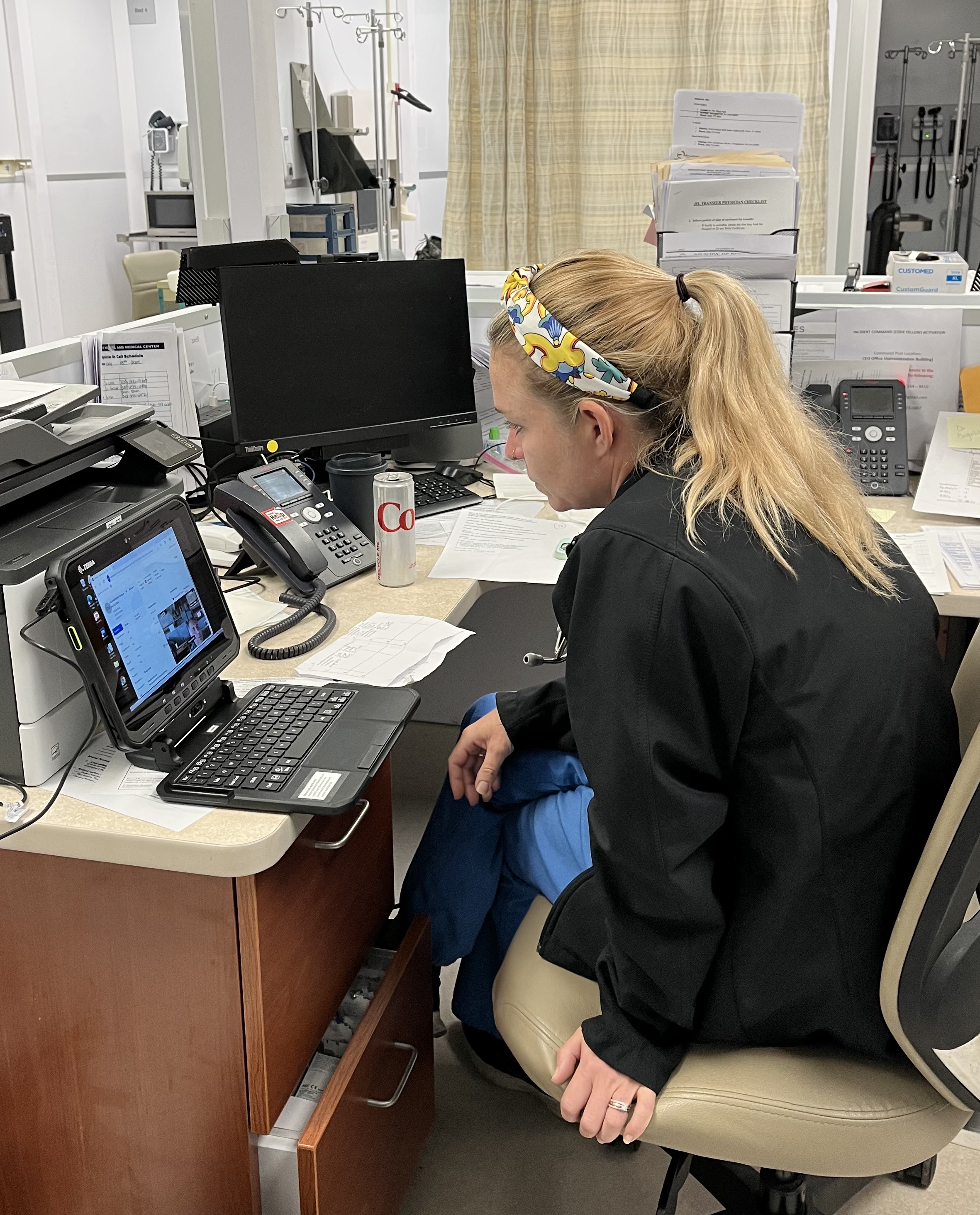
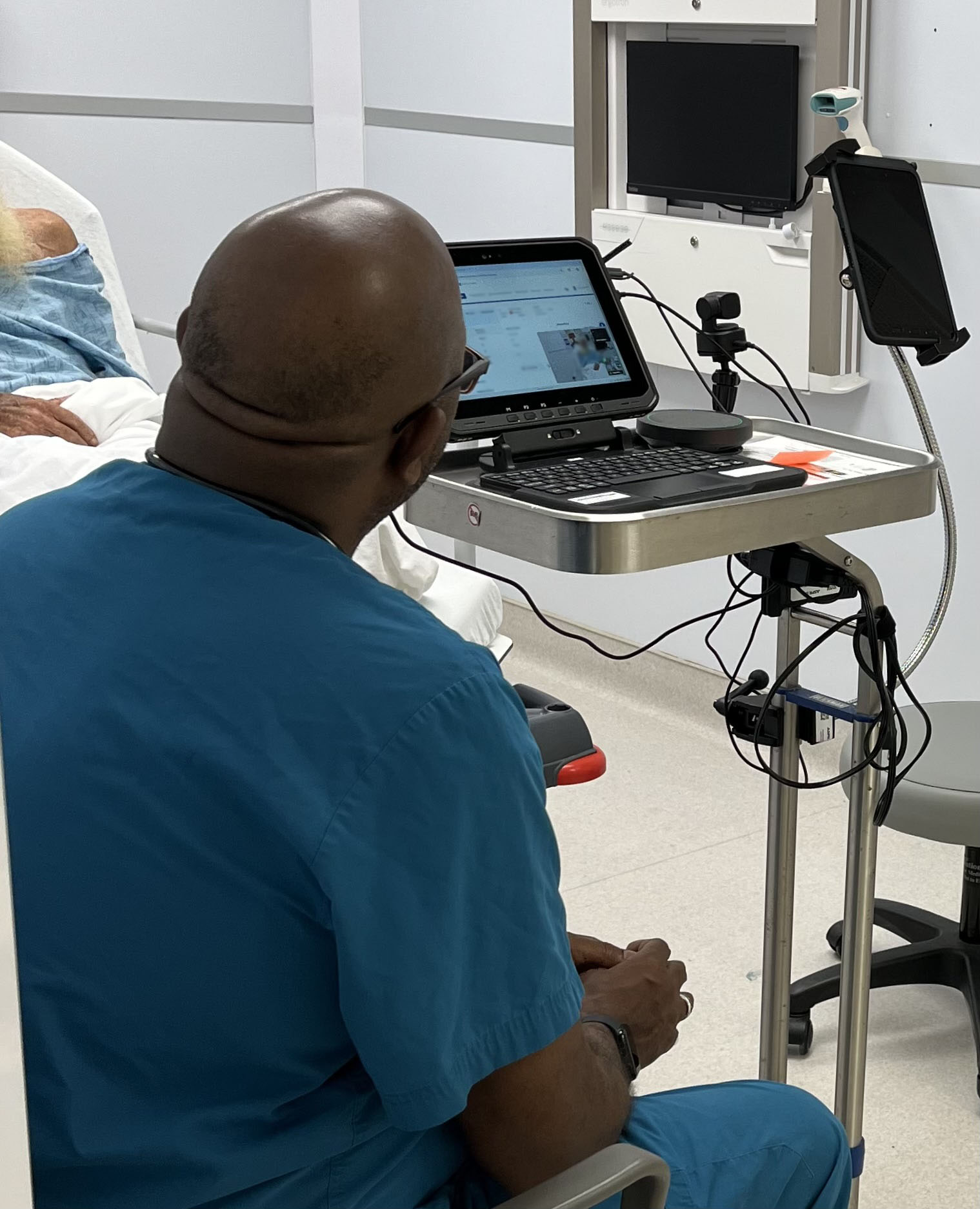
ASPR's Disaster Telemedicine team deployed and implemented two secure, tailored telemedicine systems, including our specialized communications and diagnostic equipment. Our rugged tablets with fail-over connectivity provided secure access to the ASPR Disaster Telemedicine videoconferencing and electronic medical record platform for communications and documentation. High-fidelity audio and visual equipment enabled high quality remote specialist patient evaluations and collaborations with JFL medical staff while our integrated ultrasound offered remote guidance and interpretation for emergent point-of-care ultrasound.
Through our telemedicine provider network, requested specialists, including radiology, neurology, and psychiatry, were available 24/7 to deliver timely and accessible remote consultations. Teleradiologists, from 5 states (California, Georgia, Nevada, Pennsylvania, and Texas), interpreted urgent and emergent imaging, engaging directly with JFL medical staff as needed, also providing final radiology reports for current and back-logged diagnostic images. These resources not only helped alleviate the immediate workload stress on an overburdened system but also enabled clinicians to make faster, better-informed decisions.
JFL ER physician consulting with a remote Neurologist
Making a Measurable Impact
ASPR's Disaster Telemedicine support delivered several notable outcomes:
Over 250 radiology studies reported, including backlogged cases, helping to clear a mounting diagnostic logjam.
Within one hour, final radiology reports of emergency imaging reads with emergent findings were returned to medical staff.
Secure access to imaging enabled physicians to review images from their laptops or tablets, without leaving their departments or patients or the need to interrupt radiology technician's work to view images directly on CT or x-ray equipment.
Teleradiologist support, including radiologists and a neuroradiologist for complex neurological imaging, helped JFL manage a wide range of patient needs during the outage.
Teleneurologist support including six neurologist consults for emergency department patients. These consults supported clinical management decision making, diagnosis, and facilitated two critical transfers off-island for definitive care.
Optimized use of limited hospital staff and IT resources, ensuring that on-island personnel could maintain timely and high-quality patient care, decrease barriers to patient flow, reduce stress on hospital resources, and aid in the recovery process.
These actions were not just stopgap measures, this crisis response also generated valuable baseline data that ASPR and JFL can use to guide future telemedicine integration for steady-state as well as disaster response.
JFL ER physician observing TM Neurologist evaluating patient
A Model of Collaborative Response
"This collaboration was nothing short of extraordinary," said Darlene Baptiste, Chief Executive Officer of JFL. "We extend our heartfelt thanks to our federal and local partners, especially the dedicated teams at ASPR, VITEMA, and VIDOH, whose swift commitment and responsiveness were instrumental in preserving continuity of care during this period. Their presence and expertise brought relief and benefit to our staff and patients."
This event highlighted the strength of public health partnerships and the promise of telehealth during public health emergencies and disasters. By working together and leveraging cutting-edge tools, ASPR and its partners helped ensure that patient care was expertly delivered, even in the face of a complex cyber disruption.
Amy Keim joined ASPR one year ago as the Senior Medical Officer for Disaster Telemedicine. She has 20+ years of experience in emergency and operational medicine and an expertise in designing and implementing national/international operational medicine programs with a focus on leveraging technology to enhance medical readiness and improve patient outcomes in challenging settings.
ASPR kicks off Tranquil Passport Exercise to test new portable biocontainment unit and healthcare system’s ability to isolate and treat high-consequence infectious disease patients
Today, the Administration for Strategic Preparedness and Response (ASPR), a part of the U.S. Department of Health and Human Services (HHS), and more than 50 partner organizations began the first of several complex patient movement activities as part of the Tranquil Passport exercise. This four-day, coordinated full-scale exercise will test and validate the nation's ability to safely and securely transport simulated patients with high-consequence infectious diseases to regional treatment centers, and will demonstrate capabilities of the new Portable Biocontainment Unit (PBCU). Lessons learned will inform future exercises and real-world responses.
"Testing our new biocontainment unit makes America safer and strengthens our national security," said HHS Principal Deputy Assistant Secretary for Preparedness and Response John Knox. "This cutting-edge technology allows us to more quickly and safely transport patients to treatment centers in the U.S. for definitive care, while ensuring containment of the simulated highly infectious disease used in the exercise. Exercises like this are essential to testing our healthcare delivery systems and improving our ability to save lives and protect the health care workforce."
The Tranquil Passport exercise began with government officials facilitating a series of coordination calls to plan the movement of a cluster of simulated American high-consequence infectious disease patients from Toronto, Canada to the United States on June 24. Exercise patients were moved today using the PBCU to Washington, D.C. to be transferred to Medstar Washington Hospital Center, Children's National Medical Center, and Johns Hopkins Hospital in Baltimore, Maryland. The Department of State's Containerized Bio-Containment systems (CBCS), designed to transport high-consequence infectious disease patients via air from abroad to the U.S. for treatment, was also used.
ASPR's PBCU will be used to transport additional simulated patients for the duration of the exercise to treatment centers at Health + Hospitals/Bellevue (New York City, NY); Emory University Hospital and Children's Healthcare of Atlanta (Atlanta, GA); and University of North Carolina Medical Center (Chapel Hill, NC). These facilities are HHS supported Level 1 Regional Emerging Special Pathogen Treatment Centers (RESPTCs), part of the tiered National Special Pathogen System designed to protect patients, communities and the healthcare workforce.
The PBCU is the first domestic resource for isolating and transporting patients with high-consequence infectious diseases, such as Ebola, over long distances to RESPTCs. It is the only multi-patient, multi-modal transport solution of it's kind and it was designed and built in America. The unit can be transported over long distances by air on a C-130 or L-100 aircraft or by ground via a specialized trailer that can be pulled by a tractor or semi-truck. The new PBCU builds on and improves isolation and transport technology. The PBCU allows for continuous treatment of multiple patients isolated in the unit and for onboard care teams to switch out during longer transportation or until the patients can receive more definitive care at a RESPTC hospital. In addition to having the only domestic patient transport authority for high-consequence infectious diseases through HHS, the PBCU's interior is uniquely customizable to accommodate up to 10 ambulatory patients and reach virtually any airport in the U.S., which current technology cannot do.
HHS and the U.S. Departments of State and Defense previously collaborated on a series of exercises to move Americans acting as high-consequence infectious disease patients from overseas to the United States for treatment. A video summary of the most recent patient movement exercise in that series, Tranquil Terminus, is available for review here https://www.youtube.com/watch?v=LL1BEwy-2DQ.
Trump Administration Helps Open Cutting-Edge Facility to Boost Domestic Medical Supply Production
The Principal Deputy Assistant Secretary (PDAS) for the Administration for Strategic Preparedness and Response (ASPR), John Knox, today joined the Honorable Ambassador of Finland to the United States, Leena-Kaisa Mikkola, and senior leaders from Premix Oy, Inc., at a ribbon-cutting ceremony marking the opening of a new state-of-the-art manufacturing facility in Dallas, North Carolina. The facility will increase domestic production of pipette tip materials – essential components for diagnostics and life sciences – and create 40 jobs.
"Bringing manufacturing for medical supplies back to the United States ensures that our supply chains are secure," said PDAS John Knox. "Opening this new facility ahead of schedule delivers on President Trump's promise to prioritize American manufacturing and re-shore the production of critical medical materials."
The new state-of-the-art facility will produce 1,210 tons of Carbon Black per month. Carbon Black is a high-performance, medical-grade compound engineered for chemical resistance, dimensional stability, and clean, contaminant-free processing. It is specifically formulated to meet the rigorous standards required in life sciences and diagnostics applications.
Pipette tips are essential tools used daily by diagnostics and life sciences professionals for disease testing, blood sample analysis, and drug development. Ensuring a stable, domestic supply of pipette tips, and the raw materials used to produce them, is vital to the national healthcare system and to national security.
ASPR's Center for Industrial Base Management and Supply Chain (IBMSC), a part of the U.S. Department of Health and Human Services, previously awarded approximately $80 million to Premix Oy, Inc., to expand the domestic production of pipette tip raw material, a resin compound, required to manufacture pipette tips for diagnostics and life sciences professionals.
Trump Administration set to demonstrate point-of-care technology to help prevent IV fluid shortages
The U.S. Department of Health and Human Services' (HHS) Administration for Strategic Preparedness and Response (ASPR) today announced two locations selected to demonstrate Caspian, an automated, point-of-care, sterile saline manufacturing system that may help prevent or mitigate intravenous (IV) fluid shortages in the United States.
Caspian's development was initiated in 2019 in response to President Trump's leadership in efforts to address persistent medical supply chain disruptions, and supports the President's Executive Order: Regulatory Relief to Promote Domestic Production of Critical Medicines.
"Despite being one of the most commonly used supportive care solutions in patient care, IV fluids have been in shortage since 2018," said John Knox, Principal Deputy Assistant Secretary for the Administration for Strategic Preparedness and Response. "Under President Trump's leadership, we are helping to ensure that patients don't have their medical care delayed or cancelled due to shortages of IV fluids by manufacturing them here at home through Caspian."
On-demand, on-site production technology is critical to our efforts to reshore American manufacturing, secure domestic supply chains, and reduce U.S. dependence on foreign nations for critical medicines and therapies.
Caspian is being developed by DEKA Research and Development Corp. in Manchester, New Hampshire, with ASPR support. One Caspian unit will be delivered to Walter Reed Medical Center in Bethesda, Maryland, where it aims to demonstrate how the saline-on-demand system can help meet patients' needs in medical facilities, and the other unit will be delivered to the U.S. Food & Drug Administration for additional review.
In preparation for delivery to these locations in the Fall of 2025, ASPR is working with DEKA to complete the final steps in producing the units with the intent to produce up to 500 bags of IV fluid each day.
Automated, integrated quality controls in each Caspian unit are connected to a cloud-based quality manager to ensure all the final IV products meet all quality specifications.
West Tennessee MRC Joins Statewide Disaster Response Exercise
The West Tennessee Medical Reserve Corps (West TN MRC) participated in Vigilant Guard 2025, a large-scale disaster response exercise held across Tennessee, May 12–18, 2025.
The exercise, co-sponsored by U.S. Northern Command and the National Guard Bureau, brought together more than 30 agencies, including the Tennessee Military Department, Tennessee Emergency Management Agency, and several out-of-state National Guard units to activate and employ their response plans to improve mission command, relationships, and interoperability among federal, state, and local agencies.
West TN MRC volunteers participated in critical operations including hospital evacuations, search and rescue efforts, and emergency response coordination in the event of a simulated 7.5 magnitude earthquake along the New Madrid Seismic Zone near Tipton County.
"This kind of training is essential," said Maj. Gen. Warner Ross, Tennessee's Adjutant General. "The more we train together, the stronger our partnerships and procedures become."
The participation of the West TN MRC highlighted the vital role of volunteer medical professionals in statewide disaster preparedness and strengthened their ability to respond when real crises strike.
A Model of MRC Excellence: Dr. Marian Nowak’s Legacy of Service, Leadership, and Innovation
Dr. Marian Nowak, DNP, RN, MSN, MEd, MPH, PN, CSN, FNAP, FAAN, exemplifies the very best of what it means to be a nurse within the Medical Reserve Corps (MRC). A dedicated volunteer nurse with the South New Jersey MRC for nearly two decades, Dr. Nowak has not only served her community directly but has also cultivated the next generation of nursing leaders. She leads an innovative outreach program that connects student nurses to real-world public health and disaster response experiences; work that has had a lasting impact on both local preparedness and the professional development of future nurses.
She also developed the first-ever student nurse disaster response certificate in the United States. This groundbreaking initiative, created in collaboration with the MRC of the Philadelphia Department of Health's Division of Disaster Management and Bioterrorism, reflects Dr. Nowak's deep commitment to education, service, and community resilience. Her forward-thinking approach has created a sustainable pipeline for informed, ready, and compassionate disaster response nurses.
Dr. Nowak's work extends far beyond her local community. She has served as the Pan American President of the International Catholic Committee of Nurses and Medico-Social Assistants (CICIAMS) since 2016 and was a member of the CICIAMS UN Delegation from 2015 to 2023, advocating for global health priorities. In 2020 she was honored for her work in disaster nursing education and service at the United Nations International Nurses Day. Her long-standing roles as a parish nurse and Eucharistic minister further highlight her holistic approach to healing and service. While serving with both the American Red Cross Disaster Response Nurse and the Medical Reserve Corps, she has provided support to communities as they face and recover from disasters and emergencies.
Her ongoing involvement with the Quality and Safety in Nursing Education (QSEN) International Task Force since 2016 underscores her influence in shaping nursing standards and best practices. Through every role, Dr. Nowak brings expertise, compassion, and a tireless dedication to improving community health outcomes.
Dr. Marian Nowak's story is one of many that illuminate the extraordinary work being done by MRC nurses across the country. Her service is a testament to the impact that dedicated, energetic, compassionate people can make to the people in their communities, the next generation, and communities around the world.