Hospital Preparedness Program (HPP)
Through the Hospital Preparedness Program, ASPR prepares the health care delivery system to save lives during disasters and emergencies that exceed the day-to-day capacity of health care and emergency response systems. The Hospital Preparedness Program is the primary source of federal funding for health care preparedness and response.
ASPR provides Hospital Preparedness Program funding and guidance to 62 recipients through cooperative agreements to enhance the capacity of the health care delivery system to plan for and respond to disasters and emergencies. Recipients include governments of all U.S. states, territories and freely associated states, the District of Columbia, Chicago, New York City, and Los Angeles County. Hospital Preparedness Program recipients in turn distribute funding, resources, and other support to health care coalitions within their jurisdictions to meet community needs.
Established in 2002 to prepare the nation’s health care delivery system for emergencies in the wake of the 9/11 attacks, 2001 anthrax attacks, and other disasters and public health emergencies, the Hospital Preparedness Program is now in its third decade. ASPR continues to evolve and strengthen the Hospital Preparedness Program to address the shifting threat landscape that recipients face. Hospital Preparedness Program recipients’ and health care coalitions’ impact during disaster responses clearly demonstrates that investment in health care readiness saves lives. Through support of health care coalitions, the Hospital Preparedness Program improves patient outcomes, minimizes the need for federal and supplemental state resources during large-scale emergencies, and enables rapid recovery in the wake of disaster.
Program improves patient outcomes, minimizes the need for federal and supplemental state resources during large-scale emergencies, and enables rapid recovery in the wake of disaster.
What is a health care coalition?
A health care coalition is a network of public and private health care and response organizations in a defined geographic location that:
Partner to conduct preparedness activities (e.g., exercises, training)
Collaborate to make sure that each member has what it needs to respond to disasters and emergencies (e.g., equipment and supplies, real-time information, communication systems)
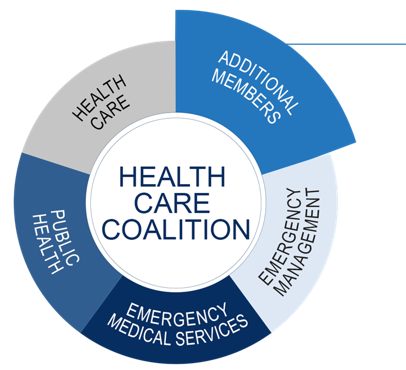
Potential additional members, as determined by the needs of the community served by a health care coalition:
State, local tribal, and territorial partners
Community organizations that represent and/or serve communities most impacted by disasters
Critical infrastructure entities
Federal Partners
Long-term care facilities
Mental and behaviorial health entities
Specialty care entities
Supply chain entities
Health care coalition members represent a wide range of health care and response organizations, like hospitals and emergency medical services. These members work together to improve health care readiness in their community. Coalitions incentivize health care organizations with differing priorities and objectives to work together to prepare for, respond to, and recover from all types of threats and emergencies.
How do health care coalitions prepare for disasters or emergencies?
Health care coalitions promote collaboration among members and prepare each member to respond to disasters and emergencies. Health care coalitions conduct critical preparedness activities, including:
Coordinating joint exercises with members
Performing assessments to evaluate gaps and priorities
Developing communications protocols and systems
Providing medical equipment and supplies
Educating and training health care personnel
As part of the Hospital Preparedness Program, health care coalitions lead their members in readiness exercises and assessments such as the Medical Response and Surge Exercise (MRSE). Through the MRSE, health care coalitions develop and implement an exercise scenario that tests their ability to respond to a medical surge event. Exercises like the MRSE enable health care coalitions to test their coordination and communication, identify gaps in preparedness, and develop corrective action plans to strengthen preparedness for future efforts. Health care coalitions use the findings from these trainings and exercises to inform communications protocols and plans, educate and train health care personnel, and develop targeted strategies for training, recruitment, and partner engagement.
Health care coalitions perform various assessments, such as risk assessments and hazard vulnerability assessments, to identify gaps and priorities for their communities. The ability to anticipate challenges and mitigate risks enables decision-making and resource allocation that is based on the needs of each individual community, rather than a “one-size-fits-all” approach. The results of these assessments promote a risk-informed approach for health care coalitions to coordinate needs, define activities, and exercise plans based on their specific risks, gaps, and strengths.
How do health care coalitions enable faster, more efficient responses to disasters or emergencies?
Health care coalitions help save lives by making sure that every coalition member has the resources and information needed for patients to receive the right care, at the right place, at the right time. During a disaster or emergency, health care coalitions collaborate to identify and meet community needs, foster connections among members, and strengthen the health care delivery system’s ability to continue providing care. Health care coalitions promote coordinated planning and decision-making among health care delivery system partners by distributing and sharing medical equipment, supplies, and real-time information to maintain situational awareness.
Examples detailing how health care coalitions have worked together during real-life emergencies can be found at Health Care Readiness in Action: Stories from the Field.
Why invest in health care coalitions?
Health care entities normally operate independently of one another as they provide care to people in communities across the country; however, when disaster strikes, these entities must have strong plans and partnerships in place to overcome the challenges they face and help save lives. Hospital Preparedness Program funding supports health care coalitions with critical day-to-day preparedness activities, such as developing patient tracking and bed availability dashboards, developing plans to mitigate the effects of cyberattacks, and conducting exercises to better prepare for and respond to disasters and emergencies. Health care coalitions help save lives by making sure that every coalition member has the resources and information needed for patients to receive the right care, at the right place, at the right time.