A Florida HCC’s Preparedness Activities Enhance Response during Hurricane Michael

A Florida HCC’s Preparedness Activities Enhance Response during Hurricane Michael

Mexico Beach, FL.

October 2018

Hurricane Michael made landfall on Mexico Beach, Florida in October 2018 as a Category 5 hurricane, and was later designated the strongest storm on record to hit the Florida Panhandle. The areas of Florida most impacted by Hurricane Michael are served by the Emerald Coast Health Care Coalition (HCC), which receives funding through the Hospital Preparedness Program (HPP) cooperative agreement.

The Emerald Coast HCC, which covers more than 10 counties in Northwest Florida, facilitates collaboration across its 600 participating organizations and works to strengthen the acute care medical surge capacity of hospitals in the region. Members of the Emerald Coast HCC have access to activities and exercises that maximize their ability to respond to emergencies and disasters.

In November 2017, the coalition used HPP funds to conduct regional trainings and tabletop exercises, including the Coalition Surge Test (CST), which is an exercise all HCCs conduct annually to identify gaps in surge and response readiness. These activities provide opportunities for coalition staff to test evacuation plans and procedures, as well as develop strategies for successful responses to disasters and emergencies. By participating in HPP-funded activities, like the CST, the Emerald Coast HCC was able to build a base level of readiness long before disaster struck.

"If the HCC had not pushed us to complete the CST tabletop exercise, we might have failed to execute a timely response," said representatives of the Bay Medical Center. "Thanks to the training and preparation exercises facilitated by the Emerald Coast HCC, we had the right forms and supplies in place to successfully evacuate within 36 hours."

The coalition's preparedness activities were instrumental in their coordinated response to Hurricane Michael. As the storm approached, the coalition contacted the State of Florida, who facilitated the evacuation of more than 6,000 patients from health care facilities over the course of eight days. Coalition contacts worked together to make the calls needed to provide evacuation assistance, and the State of Florida Department of Health, Division of Preparedness and State agents working under FEMA's Emergency Support Function 8 (ESF-8) worked with federal entities to provide the evacuation equipment, personnel, and patient tracking. Throughout the response, the coalition worked with the state and its health care partners to share information.

By participating in HPP-funded preparedness exercises, the Emerald Coast HCC was able to reduce the burden on individual facilities and maintain high quality of care for those affected by the hurricane.

Hurricane Michael Fast Facts

wind symbol

Sustained Winds of more than 160 miles per hour

 

wind symbol

Power outages for more than 1.2 million people

 

hospital

Evacuation of 74 health care facilities
Responding to Hurricane Florence: Coordinating State Medical Support Shelters through an HCC-centered State Medical Response System

Responding to Hurricane Florence: Coordinating State Medical Support Shelters through an HCC-centered State Medical Response System

Wrightsville Beach, NC 

September 2018 

On September 14, 2018, Hurricane Florence made landfall just south of Wrightsville Beach, North Carolina with winds whipping at 105 miles per hour. The hurricane would eventually require over 700,000 evacuations, impacting patients from over 250 medical facilities – including those requiring dialysis, mental health care, and long-term nursing home needs. The response required the coordination and movement of hundreds of patients with specialized health care needs, many of whom had varying levels of notice to arrange for their regular treatments or medication. Thanks to the state and HCC-coordinated response, the foundation of which was funded by ASPR's Hospital Preparedness Program (HPP), these vulnerable populations were relocated, cared for, and far from forgotten.

patient movementNorth Carolina's Health Care Coalitions (HCC), funded by ASPR's HPP, were ready and able to lead the response. HCCs foster partnerships and planning between hospitals, public health agencies, emergency medical services, emergency management, and other members of the health care community. They also use HPP funds to develop action plans, conduct trainings, and implement interoperable communication systems throughout the year to prepare for and respond to emergencies.

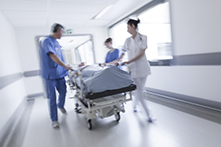
In the days leading up to Hurricane Florence, North Carolina activated all eight regional HCCs through their State Medical Response System (SMRS). Once activated, HCCs began command and oversight for five State Medical Support Shelters, coordinating staffing and logistics for each. HCCs held daily calls with hospitals to receive patient lists, verify information, and initiate over 112 patient transfers to hospitals across the state and over 300 patient transfers to a State Medical Support Shelter.

Multiple HCCs, including Duke Healthcare Preparedness Coalition, Mid Carolina Healthcare Preparedness Coalition and CapRAC Healthcare Preparedness Coalition, teamed up to establish a 100-bed State Medical Support Shelter, which provided 24/7 medical care for patients that had lost their community health care support due to the storm. This shelter was designated to treat at-risk patients who required assistance with activities of daily living or skilled nursing home-level care beyond what a general shelter could provide. Fortunately, the HCCs had done extensive preparation, and already had advanced plans to set up the shelter operations, obtain equipment, and staff the shelter with qualified physicians, nurses, and paramedics.

The HCCs also played a vital role in integrating the shelter with the community, both by connecting with health care stakeholders across the state and by facilitating a continued sense of compassion within the shelter. For patients who were evacuated with little to no notice, HCCs coordinated with local pharmacies and hospital systems to obtain their necessary medications so the drastic effects of the hurricane would not be compounded by patients missing vital medications. Additionally, HCCs identified nursing homes and home care providers who could more thoroughly accommodate the long-term needs of patients in the shelter – an effort the HCCs will continue to work towards incorporating in future preparedness planning.

"Thanks to the HCCs, these vulnerable patients received continuity in their care and were able to stay outside the already crowded emergency departments, where at-risk patients so often end up during disasters," said Dr. Brenda Lanan, Medical Director of the Duke Healthcare Preparedness Coalition, who provided on-the-ground support in the State Medical Support Shelter. "Our entire community was invested in making sure the shelter was operating successfully, and had the right materials in place for patients requiring specialized medical attention. HPP and the Duke Healthcare Preparedness Coalition allowed us to not only direct patients to the right shelter, but also ensure that our most vulnerable were not overlooked."
 

Regional coordination and patient tracking during passenger train derailment response

Regional coordination and patient tracking during passenger train derailment response

Pierce/Thurston Co., WashingtonDecember 2017

In December 2017, on a trip inaugurating a new route from Seattle, Washington, to Portland, Oregon a passenger train derailed near the border of Washington's Pierce and Thurston counties. The Northwest Healthcare Response Network ("the Network") led a critical role in coordinating the health care system's response.

Supported in part by the Hospital Preparedness Program (HPP), the Network leads the health care coalition encompassing King, Kitsap, and Pierce counties, and serves the largest concentration of health care organizations in Washington State. The Network has strengthened the region's health care preparedness and response capabilities since 2005.

Thirteen cars left the track when the train derailed, some spilling into morning rush-hour traffic on Interstate 5 below. The derailment occurred near the border of two counties and two coalitions, requiring cross-jurisdictional coordination between the Network's coalition partners and the Region 3 Healthcare Coalition.

"Because of where the train derailed, we knew right away that we would need to coordinate with the coalition south of us," said Onora Lien, Executive Director of the Network. "Thanks to HPP-funded planning efforts, we've built relationships with our neighboring coalitions, and we were able to leverage those relationships throughout the response."

Within an hour of the incident, the Network activated its Healthcare Emergency Coordination Center and Washington's HPP-funded patient tracking system, WATrac. Led by Washington's Department of Health, WATrac serves as a statewide, web-based tool for health care bed availability and communications, with a module dedicated to patient tracking. Along with WATrac, the Network uses a detailed Regional Patient Tracking Concept of Operations plan that outlines the roles and responsibilities of coalition partners.

"For many years we have worked with local partners on mass casualty incident plans," said Lien. "Many of the benefits of this work came to light during the response. Hospitals and EMS across both coalitions implemented their mass casualty incident plans and responded, providing timely distribution of patients and ongoing patient care."

Patient tracking during large mass-casualty incidents (MCIs) often poses significant challenges, ranging from identifying patients to maintaining confidentiality. Yet in this response, patient tracking was a stellar example of putting the coalition's practice into action.

Area hospitals used WATrac and coordinated with the Network to document the arrival of injured patients, just as they had planned and exercised with the Network's guidance.

"Coalition members and health care partners were nothing short of amazing when it came to patient tracking," said Susan Pelaez, Director of Preparedness and Response at the Network.

According to Lien, having the Network lead coordination among these entities streamlined patient tracking and distribution while minimizing disruption to patient care. During the course of the response, nine hospitals across three counties received 69 patients, ten of which were children; there were three fatalities in all.

Family reunification is another benefit of having a patient tracking system. The Network acted as a liaison between the health care community, the rail line, and the National Transportation Safety Board toward this end.

Working in partnership with area hospitals, the rail line, and local responders, the Network helped to reconcile the passenger manifest with the patient tracking data by the end of day one – a feat that earned praise from county health officials and rail line representatives alike.

"The Network's response throughout the train derailment incident was impressive," said Nigel Turner, Division Director, Tacoma-Pierce County Health Department. "The staff demonstrated all the exceptional skills and capabilities of an expert health care coalition."

This was not the Network's first time responding to an MCI. In September 2015, a tour bus crashed on Seattle's Aurora Bridge, killing five students and injuring 71 others. The Network supported the health care system response to that event, too, tracking all injured bus passengers across the seven area hospitals.

Following the bus crash, many of the Network's drills and planning activities focused on strengthening MCI response capabilities, such as patient tracking and support for family reunification. As a result, the Network was ready to respond to the 2017 derailment.

"It's almost hard to envision how this response might have unfolded without HPP funding," Lien remarked. "We're fortunate to have a community that is committed to quality of patient care and to collaboration, but HPP funding is at the core of what builds our community capacity to respond to these events."

Local Paramedic’s First Deployment is to Help Family, Friends, & Neighbors After Hurricane Maria: Now He Says, “I’m NDMS for Life!”

Local Paramedic’s First Deployment is to Help Family, Friends, & Neighbors After Hurricane Maria: Now He Says, “I’m NDMS for Life!”

Rafael Baucage has lived his entire life in Aguadilla, a community of 60,000 on the west coast of Puerto Rico that, before Hurricane Maria, was best known for its beautiful beaches and its very popular Parque Acuático Las Cascadas, the only aquatic theme park in the Caribbean.

Post Hurricane Maria, his beloved community is in shambles. Rafael's' home was located in the middle of the hardest hit area in Aguadilla. More than three feet of water seeped through the walls of his home, which he shares with his wife Maria and their 15-year-old twins.

On September 22, two days after Hurricane Maria struck, Rafael was able to locate his NDMS administrative officer. His first question was, "Are you ok?" His second question: "What can I do? I'm here. I'm ok. My wife and children are ok, and I'm ready to help."

Image
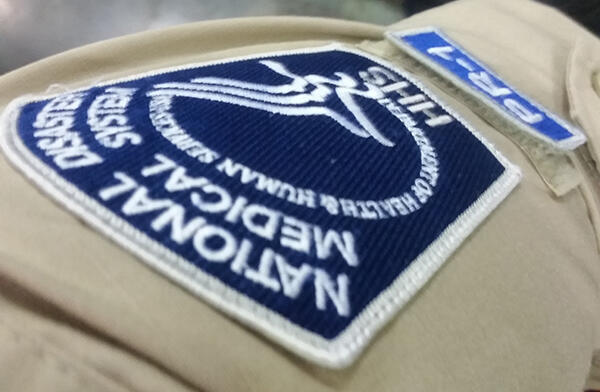
An image of the National Disaster Medical System uniform sleeve

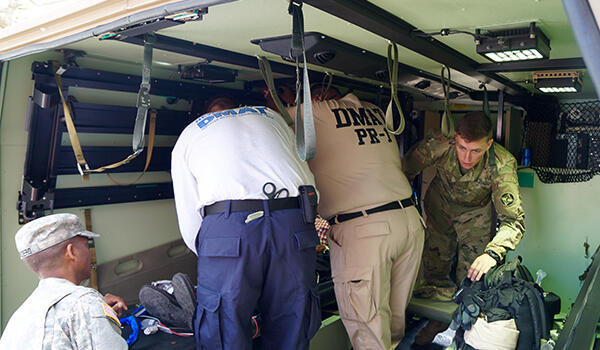
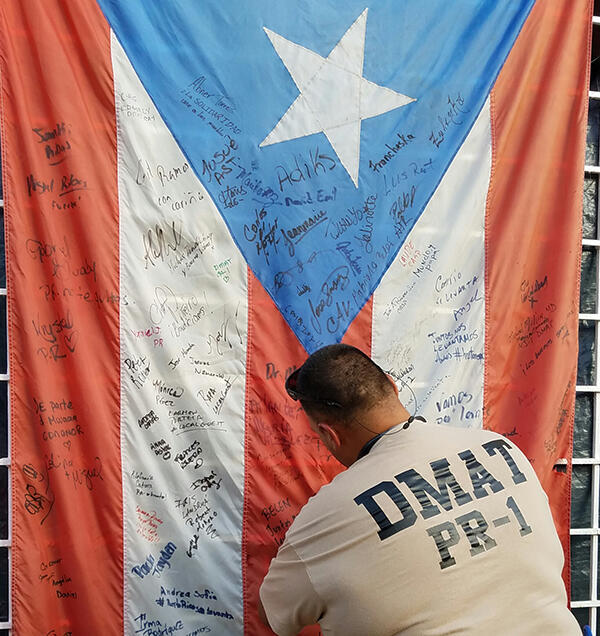
The hurricane marked Rafael's first deployment as a paramedic for the U.S. Department of Health and Human Services (HHS), National Disaster Medical System (NDMS). Although he has been a member of NDMS' Disaster Medical Assistance Team (DMAT) since 2009, this is the first time his team has been deployed to a federal disaster zone, and it just happens to be in their own backyard.

Since his deployment, Rafael has been doing what he is most passionate about: working as a paramedic on an ambulance. Four days ago, Rafael found a patient outside unconscious just around the corner from where his team set up a medical area on the town's main street. "I got the doctors and nurses who stabilized him and then I transported him to Centro Medico in San Juan. It was my birthday that day, and helping that patient was my best birthday gift."

Image
NDMS team working on a patient  on an ambulance

For the last three weeks, Raphael has helped many patients, often transferring them down a mountain and across debris-filled streets to Centro Medico more than 90 miles away or bringing patients from his community back to the medical tents set up on main street. During these transports he sees people from his neighborhood doing everything they can: cutting up trees, removing debris, repairing their homes and cleaning the streets. Everyone is working together to help each other and make things better.

Although as awful as this storm is, Rafael says serving his community with NDMS has been a great experience for him. "The doctors, nurses, and EMTs on my DMAT are great." According to Rafael, the best part about serving on the team is that he got to work with NDMS team members from California and New Jersey. These folks have been deployed to many disasters, and have a great deal of experience that they to share.

This may be Rafael's first deployment, but he says: "I'm NDMS for life! I'm so glad I have this knowledge for my future job and deployments are one way to get even better at what I do."

Rafael's story is just one of many from NDMS responders helping patients get the care that they need and supporting the health care system as it recovers from Hurricane Maria. There are many great ways for both medical and non-medical professionals to help communities in the wake of a disaster, but the best time to choose to serve is before a disaster strikes. Are you up for the challenge? Take a few minutes to learn how you can help the next time disaster strikes, visit Joining NDMS . 

Image
An image of the National Disaster Medical System uniform sleeve

Dedication and Deployment: A Couple Chooses to Serve with NDMS

Dedication and Deployment: A Couple Chooses to Serve with NDMS

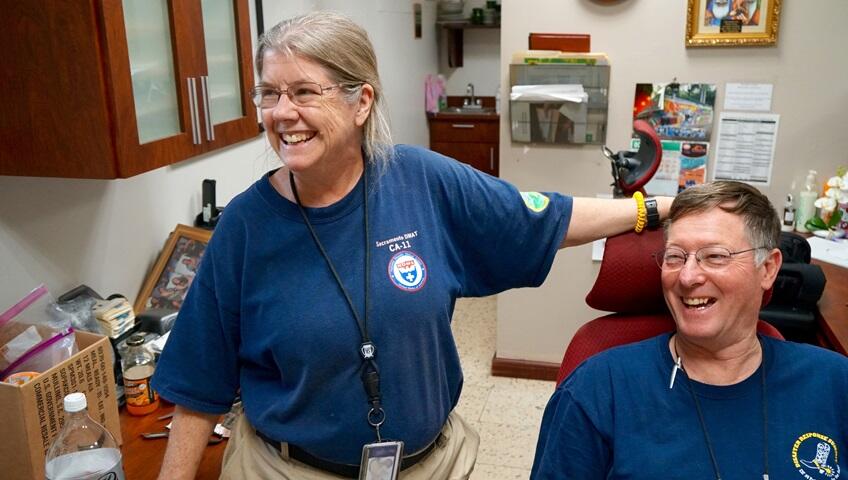
Ever since we were fifteen, Don and I have loved to do things together. We even deploy together with the National Disaster Medical System (NDMS).

Don and Susan Wyatt

This time, we deployed to Comerío, Puerto Rico, where I helped set up and staff the pharmacy and served as a nurse. The community was truly devastated by the storms. Most of the medical facilities were concentrated in one part of town. When that area flooded, it wiped out most of the town's healthcare resources. Comerío has been completely cut off from grid power – any power that we have here comes from generators.

When I'm deployed, I get to connect with my patients on a very deep level and I get to stretch my limits. I give a part of myself to these patients and I get to do the hard stuff. I've worked as a nurse for a long time and I'm proud to be good at my job, but it is rarely really challenging. When I deploy, I take on tough challenges and see the rewards in the faces of the people that I help.

I also love being able to connect with patients and helping them become healthy enough to face the challenges that lie ahead. I don't just want to give them a pill or quickly stop the bleeding. I want to help heal the patient.

I am honored to be able to touch people during some of the most vulnerable times in their lives. My patients back home in Modesto, California, have their own homes to go back to and a few area hospitals to choose from. Many here in Puerto Rico don't. I get a chance to help not only our patients, but also their families who are worried and scared. It is an amazing experience.

Service is a wonderful thing to share. My husband and I deploy together, so he gets it. He understands how elated I feel when I've helped heal one of my patients. He knows how hard it is to deploy to a place that is devastated and how rewarding it is to help take away some of that pain. NDMS is both a really special part of my life and a very important part of our marriage.

Deploying together has some practical benefits too. When you are deployed, you usually work long days, and it can be hard to call home. When you deploy together, you get to see each other and reconnect.

Of course, you don't have to be married and deploy together to be called to serve with NDMS. You don't even need to be a medical professional. Medical professionals don't work in a vacuum. They need temporary medical facilities with electricity and communications; people to handle logistics; and much, much more. It takes many different kinds of expertise to protect health and save lives in a disaster.

There are many different ways to serve with NDMS. If you think that you are up for the challenge, take some time to learn more. Visit  Joining NDMS . 

Responding to Harvey: How a Houston-area health care coalition modeled success

Responding to Harvey: How a Houston-area health care coalition modeled success

Houston, TX 

August 2017

On August 27, 2017, at the height of Hurricane Harvey's catastrophic winds and rain, a 54-year-old man with a serious head injury arrived at the Harris Health System's Lyndon B. Johnson (LBJ) Hospital Emergency Department in Houston, Texas. As a Level III trauma center, the hospital needed additional personnel and resources to treat the man; he needed to be transported to a Level I trauma center for neurosurgery.

Hospital officials asked for transport assistance, but the weather conditions were so severe that roads were impassable and helicopter transports were grounded. A colorectal surgeon at LBJ eventually performed the necessary emergency surgery to save the patient's life, but he still needed care and monitoring in a Level I center.

HPP team reviewing plans

Fortunately, LBJ Hospital is part of the SouthEast Texas Regional Advisory Council (SETRAC), a Houston-area health care coalition that fosters partnerships and planning between hospitals, public health agencies, emergency medical services, and other members of the health care, medical, and response community. The coalition's Catastrophic Medical Operations Center (CMOC) contacted the U.S. Coast Guard to coordinate patient transport, and shortly after surgery the patient was transferred to a Level I center where he received the ongoing care he needed.

This example of coordinated coalition response was one of many during the 17-day disaster event.

SETRAC serves as a model for building and maintaining a successful health care coalition and leveraging that coalition in disaster response. Crucial to its success were resources provided by the Hospital Preparedness Program (HPP).

HPP provides federal funding, guidance, and technical assistance to promote health care system preparedness and response. The program brings together key players in health care and emergency response disciplines to prepare for, respond to, and recover from large-scale disasters. HPP funding allows SETRAC to conduct regular communication drills, hold regional exercises, and test preparedness and response capabilities. SETRAC counts the strong commitment of coalition members and robust buy-in from local jurisdictions as critical components for their success.

HPP promotes the development and maturation of health care coalitions and drives discussion around response capabilities. Response is the yardstick by which a health care coalition's success is measured. This is not lost on SETRAC; over the past ten years, the coalition has shifted from purchasing supplies to investing in education and training. Coalition members often prefer investing in people at SETRAC who can help coordinate, plan, and respond, rather than buying medical supplies and equipment for individual facilities.

According to Lori Upton, RN, BSN, MS, CEM, SETRAC's Director of Preparedness, CMOC mediated the coalition's successful response. CMOC operated as a single coordinating entity during the disaster – an important function of effective health care coalitions – by overseeing information management, brokering requests for assistance and supplies, coordinating patient movement, and providing situational awareness across emergency response disciplines.

Although CMOC had been activated previously during localized flooding and for major public events such as the Super Bowl, Hurricane Harvey was different: The storm delivered more than five feet of rain in just two days and caused epic flooding in the region.

Regular communication between CMOC, SETRAC's partners, the U.S. Department of Health and Human Services, and the military ensured that crucial information about coalition status, weather reports, partner needs, and patient movements remained up-to-date and readily available. During the disaster, CMOC coordinated a wide range of activities, including:

statistics icons

The coalition also participated in efforts to ensure that dialysis patients who were trapped in their homes or relocated to evacuation centers could continue to receive treatment.

When measured in terms of saved lives and reduced suffering, SETRAC's response to Hurricane Harvey was a clear success. Fundamental to that success was the coalition's relationship with HPP. "We use HPP as a foundation to identify gaps in preparedness and determine funding priorities," says Upton. "HPP has allowed us to move concepts into realities."

For more information about how SETRAC's Catastrophic Medical Operations Center works, check out this Q & A with Lori Upton.

If HPP has helped your community respond to a disaster, share your story!

Answering the Tough Questions: Kentucky’s Region 7 HCC Ebola Response Exercise

Answering the Tough Questions: Kentucky’s Region 7 HCC Ebola Response Exercise

Edgewood, KY

2016

The 2014 Ebola virus outbreak in West Africa shocked the world. Questions and fears grew as the virus crossed international borders and health care workers fell ill. Health care organizations in the United States faced the real possibility of an Ebola patient arriving on their doorstep – were they ready?

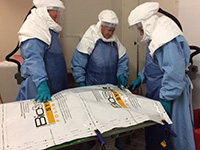
Medical personnel in protective clothing.

Two years after the Ebola virus outbreak first began, Kentucky's Region 7 health care coalition (HCC) – a network of hospitals, emergency medical services, public health departments, and emergency management agencies – continues to train, exercise, and plan together for the possibility of a patient with a highly infectious disease presenting at a local health care facility. With funding from the Hospital Preparedness Program (HPP), Region 7 HCC members collaborate so that each member has the necessary medical equipment and supplies, real-time information, communication systems, and trained health care personnel to respond to emergencies like Ebola and save lives.

With HPP cooperative agreement funding, Region 7 HCC members conducted an Ebola response exercise in October 2016. The exercise scenario involved a very sick patient arriving at the Emergency Department at St. Elizabeth Hospital – Edgewood, a Region 7 HCC member and one of Kentucky's Ebola assessment hospitals. In the exercise scenario, hospital staff suspected that the patient was infected with Ebola after conducting an intake interview. The hospital immediately implemented their Ebola Response Plan. However, before the patient could be transferred to an Ebola treatment center, the patient died.

Hospital staff, the Kentucky Department for Public Health (KDPH), members of Kentucky's Infectious Disease Fatality Management Team (IDFMT), and numerous observers and evaluators participated in the day-long exercise. In 2014, St. Elizabeth Hospital – Edgewood used both HPP and private funds to construct a replica of its intensive care unit for conducting realistic patient care trainings. HCC members exercised inside the replica unit, practicing complicated clinical techniques and procedures; rehearsing navigation around tight corners and in hallways while wearing bulky protective gear; and assessing existing plans and protocols. HCC members also practiced using HPP-funded specialized equipment to prepare the deceased patient's body for transport and protect those involved with the decedent's care. The exercise tested KDPH, IDFMT, and St. Elizabeth Hospital – Edgewood guidelines and procedures for clarity and utility, as well as strengthened relationships between HCC members.

The exercise brought to light the need for clearer instructions and more practice donning and doffing personal protective equipment to ensure practitioners' safety during a real-world emergency. "We are updating our guidance and protocols to be as precise as possible," commented Ms. Jasie Logsdon, a KDPH Healthcare Preparedness Coordinator. "We are capturing lessons-learned in an after action report to inform our future efforts. This exercise was critical in helping us identify gaps, and we would not have been able to conduct this exercise without HPP funding and guidance."

Olsson learned from this exercise will be applied to improve incident command and standard operating guidance for future HCC exercises and joint responses across Kentucky. As noted by Ms. Jessica McElroy, the Region 7 HCC Coordinator, it is critical for the IDFMT to exercise with each of Kentucky's six Ebola assessment hospitals in order to be familiar with each hospital's staff, facilities, and procedures. "By continuing to plan, coordinate, and exercise together, we know we are prepared and able to work together to protect the citizens of Kentucky from highly infectious diseases," reflected Mr. David Guethlein, the Disaster Chairman for St. Elizabeth's Hospital. "We are proud of what we have accomplished together in Region 7 with support from HPP – we know what we need to do to help keep Kentucky safe during the next major outbreak."

HCC Response to Heating Crisis Keeps 2,000 Residents Warm and Home for the Holidays

HCC Response to Heating Crisis Keeps 2,000 Residents Warm and Home for the Holidays

L'Anse, MI 

December 2016

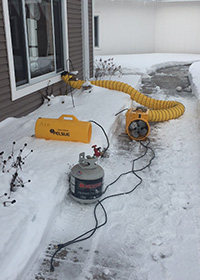
Inimage of an propane heater attached to a home in snowy Michigan the dead of a Midwestern winter just before the holidays, a young driver fell asleep at the wheel of his car, crashing into a natural gas pipe station in the predominately tribal community of L'Anse, Michigan. 1,200 residences, a long-term care facility, and a critical access hospital were left without heat as the temperature dropped to 25 degrees. While the hospital had a backup heat source, the long-term care facility did not, leaving 50 fragile long-term care residents in a critical situation. Thanks to years of exercising and training together, Michigan's Region 8 Health Care Coalition (HCC) members were prepared to respond. HCC members rapidly coordinated a supplemental heating plan for the long-term care facility using heating equipment acquired with Hospital Preparedness Program (HPP) funding. As a result, patients were able to continue receiving care in their facility throughout the three-day gas outage and were not forced to risk complications by evacuating 60 miles across the rural region to another facility.

In addition to keeping the long-term care patients safe, HCC members cared for over 2,000 other community residents whose homes also lost heat due to the accident. The HCC coordinated with county emergency management, the tribal health care agency, and the county health department to establish three emergency warming stations around the community, providing lifesaving heat and provisions for residents, many of whom could not afford or access their own backup heat sources and may have become sick, injured, or died from exposure to the bitter cold. HCC members used cots, bedding, and heat sources from their HPP-funded cache of supplies and equipment to furnish the warming stations. Thanks to the HCC's efficient response, L'Anse residents were able to spend the holidays in their community, safe from the elements.

The HCC's strong relationships, communication, and coordinated plans developed through years of HPP-funded exercises, as well as their robust cache of HPP-funded emergency equipment, prevented any loss of life during the multi-day heating crisis. The coordinated preparation and response meant that even the most vulnerable community members did not have to leave their community. "Without HCC support, members of our community may have suffered hypothermia and related life-threatening conditions or have been forced to evacuate, separating families during the holiday season," noted Mr. Jonathan Stone, the Michigan Region 8 HCC coordinator. "Our HCC would not have been able to support and serve our community without HPP funding, training, and guidance. When we look around our community, we see people whose lives have benefited directly from HPP."

Exercising for Preparedness-Pediatric Safety and Planning

Exercising for Preparedness-Pediatric Safety and Planning

Arizona
December 2015

Children have special needs that must be incorporated into emergency preparedness and response efforts and in order to adequately protect them, the health care community requires opportunities to learn new information, collaborate, and share best practices to ensure children are appropriately cared for during emergency events.

The Arizona Pediatric Disaster Coalition, a health care coalition (HCC) supported through the Hospital Preparedness Program (HPP), recognized the pressing need to prioritize pediatric patients and involve the education system in preparedness efforts. In December 2015, a joint exercise, funded in part through the Arizona Department of Health Services HPP cooperative agreement, evaluated how schools and hospitals interact in the wake of an emergency. The outcomes of the exercise played a direct role in improving relationships between hospitals and schools and helped to streamline emergency response care for the most vulnerable population. The exercise took a medical surge exercise model and creatively tailored the design to include schools and unaccompanied and injured minors. Health care workers, school administrators, and teachers participated along with law enforcement, emergency medical services, and other emergency response personnel to comprehensively test a response centered on the needs of society's most vulnerable members. Within this revised model, health care and education partners ran through a myriad of difficult scenarios, including how best to handle multiple minors separated from guardians. They also tackled thorny issues, such as obtaining consent to care for minors and family reunification.

During each scenario, the team evaluated gaps to identify areas for improvement. The exercise highlighted the fact that many hospitals and schools do not have a clear understanding of what activities they should be performing during an emergency and who should lead these activities. Even basic terminology used across disciplines posed challenges in getting the differing groups to rapidly and effectively communicate. In addition, the exercise highlighted the clear need for HCCs and their members to have family reunification standard operating procedures to ensure that families are swiftly and correctly reunited in the wake of an emergency and prompted discussions regarding community behavioral health needs and the special support that families, hospital personnel and children need after a traumatic event.

ASPR HPP's funding and resources were pivotal to the informative Arizona Departments of Health Services and Education joint exercise. Teresa Ehnert, the Arizona Bureau Chief for Public Health Emergency Preparedness stated that "HPP enabled the innovative thinking and planning the pediatric medical exercise provided. Unprecedented in the field, we were able to start a dialogue concerning the gaps in our current disaster preparedness, response, and recovery model, particularly as it relates to pediatric populations. HPP contributed to not only rallying the correct health care professionals together, it enabled us to employ a creative lens in addressing a pressing community need."

Drive-thru Flu Vaccinations in Virginia

Drive-thru Flu Vaccinations in Virginia

Stauton, VA

October 2015

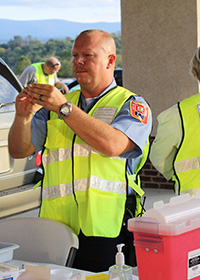
First Responder Virginia drive thru flu clinic

Since 2012, ASPR's Hospital Preparedness Program (HPP) and CDC's Public Health Emergency Preparedness (PHEP) program have been working to align and coordinate emergency preparedness efforts, linking programs targeting the medical community and the public health sector, respectively. This program alignment contributed to a recent successful seasonal flu prevention event in Virginia.

Every year, the Virginia Department of Health (VDH) purchases about 20,000 doses of influenza vaccine that are dispensed as part of its mass vaccination exercises held across the Commonwealth. In October 2015, VDH's Central Shenandoah Health District (CSHD) vaccinated approximately 515 citizens in 2.5 hours during its 2015 drive-thru influenza point of dispensing (POD) exercise. The event featured personnel and resources, including influenza vaccine, POD trailers, and other materials, supported entirely by HPP and PHEP funds. The exercise was a great example of seamless integration of public health, health care, Medical Reserve Corps, the Community Emergency Response Team, and emergency medical services responders representing Virginia's Northwest Healthcare Coalition. Similar efforts are repeated across the Commonwealth annually.

Subscribe to