Training, Preparing, Responding: How MRC Builds More Resilient Communities
Topic:
The Medical Reserve Corps (MRC) is a small and targeted program within the HHS Administration for Strategic Preparedness and Response (ASPR) that directly supports local preparedness and response and enhances resilience across communities. MRC volunteers are organized in units by their communities to partner with public health and emergency response organizations to prepare communities before a crisis, strengthening coordination and readiness. In the aftermath of disasters, they are there on the ground, supporting response and recovery.
MRC expands public health and medical response capacity at minimal cost to the taxpayers. In 2025 MRC volunteered almost 300,000 hours, at a total value of approximately $11.7 million. MRC volunteers reduce strain on first responders, improve outcomes, and contribute to a culture of readiness in the communities they serve.
24 Years of Service
After the September 11thattacks, volunteers wanted to help, but there was no system in place that harnessed that willingness to serve. In 2002, HHS launched the MRC pilot project supporting communities to establish just 42 units. Four years later, the Pandemic and All-Hazards Preparedness Act was enacted, formally establishing the MRC as another pillar of support within communities across the nation.
Over time, Congress reauthorized and strengthened the MRC to ensure communities have the personnel and support needed to prepare for, respond to, and recover from emergencies. The authorities in the Public Health Service Act, as amended by PAHPA, enable ASPR to support recruitment, training, and coordination across hundreds of local units — creating a system that connects federal resources with community-based response. It ensures that when emergencies occur, communities are not starting from zero. They have trained volunteers already in place. That’s the difference between reacting and being ready and that’s why PAHPA reauthorization is vital.
Building Capacity Before the Crisis
Using annual funding, MRC units across the country support successful responses and recoveries long before disaster strikes by educating, training, coordinating, and preparing members of their communities.
In addition to the small annual appropriation to facilitate the general operation and integration of the national MRC network that ASPR has received, using one-time funding provided by Congress during the COVID-19 response, between 2023 and 2025, ASPR awarded MRC State, Territory and Tribal Nations, Representative Organizations for Next Generation (MRC-STTRONG) grants to 33 states and territories. States and jurisdictions used these funds to strengthen the MRC network - focusing on enhancing emergency preparedness and response.
One example of how funding has been used to directly support a community was in Maryland. In Caroline County, Maryland, the local MRC unit partnered with the health department and emergency services to launch a Citizen Preparedness Training course. This ten-week program was designed to give participants the skills and confidence to handle emergencies until professional responders arrive. Participants learned how to use fire extinguishers, perform CPR, administer naloxone, and communicate effectively during large-scale emergencies. Participants trained alongside nurses, paramedics, EMTs, and public safety professionals. Once the training was complete, participants left with not only the knowledge but also the confidence to act and the coordination in place to be effective.
In an area like Caroline, County, this supporting workforce of trained volunteers has a real impact on this rural community. When the nearest point of care is an hour away, having a local capability to mitigate immediate health issues can save lives. The MRC program ultimately improves community preparedness and resilience and offers one other alternative to mitigate immediate threats to public health.
Another example of how MRC units are supporting communities because of this one-time funding is within Puerto Rico. With the funds, the territory doubled their MRC cadre. They also established strike teams that are partnered and trained with health and emergency management officials. During a disaster, this set of MRC volunteers can be leveraged to directly support response efforts because of the investment in training opportunities for these teams.
Deploying When Communities Need Support
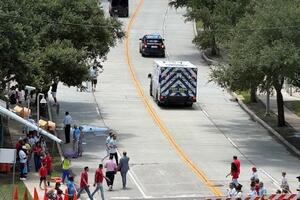
When disaster strikes, MRC volunteers step up, and what they’ve achieved is remarkable. For example, more than 30 volunteers deployed with little notice after the Brown University shooting, helping establish a reunification center, supporting survivors, and assisting incident leadership during a complex and evolving situation.
MRC volunteers have provided medical support for their communities at many National Special Security Events, and they plan to support upcoming events, including the FIFA World Cup and the America 250 celebrations in cities across the U.S.
MRC is also responding to the opioid crisis, which is the longest-running declared public health emergency in history. In 2025, MRC units in 37 states trained community members to administer opioid overdose medication; connected individuals to care; assembled and distributed naloxone kits; and more.
Celebrating MRC Volunteers
The Medical Reserve Corps demonstrates what effective preparedness looks like: locally driven, nationally supported, and built on a foundation of service. MRC proves that when individuals step forward, entire systems become stronger. To every volunteer: You are the reason neighbors are safer and healthier, responses are more effective, and recoveries are stronger. And as new challenges emerge, the Medical Reserve Corps and the spirit of service that it embodies will remain one of our nation’s great assets.
To Congress, we look forward to consideration of the reauthorization of PAHPA. Reauthorizing key authorities and programs, to include MRC, ensures that we move forward in supporting communities before, during, and after disaster.