The Bridge from Crisis to Care: How PAHPA Reauthorization Can Strengthen NDMS
When a hurricane devastates a community, a tornado touches down, or there’s a new infectious disease outbreak, patient surge may overwhelm local healthcare facilities. When specialists or beds run short, patients with treatable conditions wait as their prognoses worsen. That’s when the National Disaster Medical System (NDMS) plays a critical role.
Most Americans have never heard of the National Disaster Medical System. That’s not a failure—it’s proof the system works quietly in the background, ready for the moment it’s needed. NDMS is the nation’s medical surge force —a network of deployable teams and partner hospitals that supports states after natural and man-made disasters and provides a pathway to definitive care when capacity is exhausted.
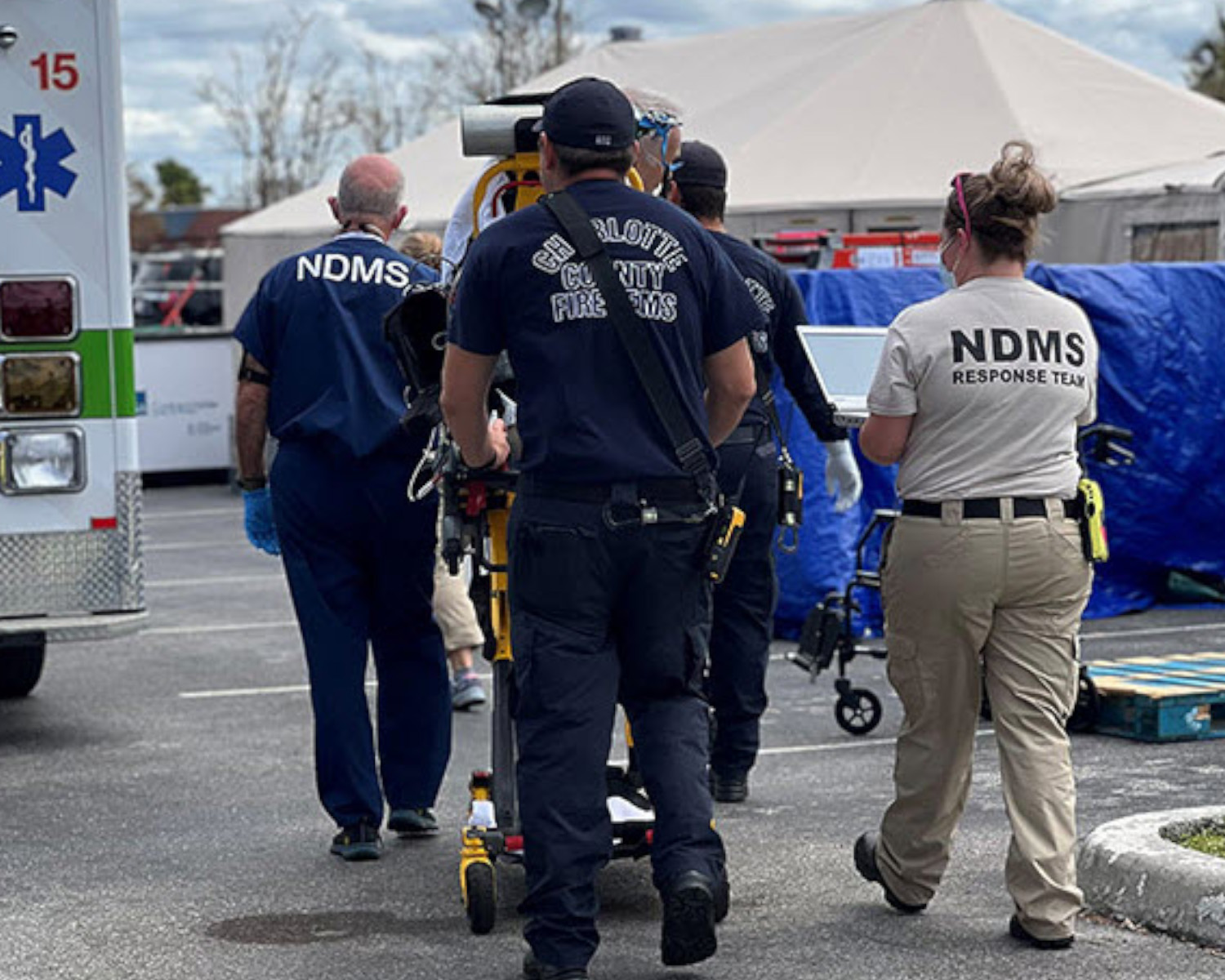
Disasters and public health emergencies stress emergency departments, inpatient wards, and critical care. Sometimes, it’s not the illnesses or injuries that strain systems: It’s the sheer volume of patients. These surges may force hospitals to operate under degraded conditions—staff shortages, supply constraints, and disrupted infrastructure—while patient needs continue for weeks, not days.
In that kind of event, two things matter as much as any countermeasure: trained people who can deploy and a nationwide system that can move patients to care.
That’s NDMS’s lane.
Delivering Care to Patients and Patients to Care
The most visible side of NDMS is the teams that deploy in an emergency. Disaster Medical Assistance Teams mobilize to provide high-quality, rapid-response medical care onsite, performing medical triage, treatment, and supplementing hospital staff. The Trauma and Critical Care Team delivers lifesaving, specialized care, often in catastrophic circumstances. National Veterinary Response Teams ensure pets, service animals, and working animals receive the care they need. Victim Identification Center and Disaster Mortuary Operational Response Teams (DMORT) help grieving families, friends, and communities find the closure they need after a mass casualty event. DMORTs are composed of fatality management specialists who assist in the identification of victim remains, support coroners who are overwhelmed by disaster, and also support dependent processing. All NDMS teams deploy at the request of federal and state partners and supplement state, local, and regional staff to help those impacted and prevent communities from becoming overwhelmed.
In a public health emergency, the Departments of Veterans Affairs (VA) and War (DoW) manage medical evacuation and patient reception through Federal Coordinating Centers. This operation is done under a network built to place patients into definitive care. The NDMS Definitive Care Program is a federally coordinated system designed to ensure that patients affected by disasters and public health emergencies can access hospital care across the United States when local capacity is overwhelmed. At a high level, the NDMS Definitive Care Program connects three essential elements: patient movement, coordination, and a nationwide care network. The NDMS Definitive Care Program sustains care and connects patients to the right destination.
The NDMS Definitive Care Program establishes and maintains a nationwide network of healthcare facilities ready to receive patients during emergencies. Today, that network includes more than 1,900 NDMS hospitals and healthcare facilities that have voluntarily agreed to participate. These partnerships open access to hospital beds when needed during large scale events. Under this system, NDMS is ready to facilitate mass patient movement during Large Scale Combat Operations (LSCO) and during massive emergencies that require large-scale movement of patients such as during Hurricane Katrina.
How PAHPA Reauthorization Can Strengthen NDMS
June 1st marks the beginning of Atlantic Hurricane Season, marking the beginning of the season when coastal communities are more likely to face devastating storms and the need for NDMS responders becomes greater. But it doesn’t matter whether the crisis is a hurricane, a terrorist incident, a chemical release, or a deliberate biological attack, the expectation is the same: Americans should not be left alone when the system is overwhelmed. NDMS exists to make that expectation real.
This is why NDMS belongs at the center of the Pandemic and All-Hazards Preparedness Act (PAHPA) reauthorization conversation. PAHPA reauthorization will ensure that existing federal capabilities that support surge capacity are available and, where possible strengthened, to actually execute during the worst day. NDMS is at the top of that list.
So, what should Congress do in PAHPA reauthorization?
Make NDMS a clear, enduring priority by doing what Congress does best: set direction and ensure readiness. Specifically:
Treat NDMS readiness as a standing national requirement, not a capability we rebuild after each crisis.
Invest in the NDMS people pipeline—recruitment, training, credentialing, and retention—so experienced members can pass the torch and the system stays deployable and modern. These professionals do not need to be trained how to be doctors, nurses, paramedics, respiratory therapists, pharmacists, fatality management professionals, or veterinarians, as they do this every day in their own communities, BUT they do need to be trained in how to perform in austere environments, operate NDMS’s equipment, and work in an incident command structure. The expertise they bring to the field to deliver high-quality care is critical, as has been proven over many years in deployments across the country.
Reinforce NDMS’s patient movement and definitive-care mission, because surge staffing without the ability to safely move and place patients is not system resilience—it’s improvisation.
We must strengthen the operational bridge between crisis and care to ensure that we have practical solutions to ensure Americans get the care they need when disasters strike or during LSCOs. NDMS is that bridge—quiet, professional, and lifesaving.
Most Americans won’t know its name. They’ll only know the outcome: that when the moment came, help arrived and provided lifesaving support.